- Home page
- Barcode scanners
- Newland NVH220 / NVH220 Blueto...
Newland
Newland NVH220 / NVH220 Bluetooth
fromPLN 434.72
See variants (3)Category
Industrial 2D barcode scanner Newland NVH220 / NVH220 Bluetooth
Newland NVH220 Lophius AI is an industrial 2D handheld scanner for direct part marking (DPM): codes laser-etched or dot-peened on metal, plastic and curved surfaces. It fits production workstations, quality control and warehouses, wherever barcodes are damaged, distorted or printed on shiny surfaces. Both versions share the same housing, image sensor, illumination and ruggedness. They differ in how they connect: NVH220 is corded, while NVH220 Bluetooth has a battery and a docking station.
Key features
- 1280 × 800 image sensor and DPM decoding: reads laser-etched and dot-peened codes as well as damaged or distorted 1D and 2D barcodes (Data Matrix, QR, Micro QR, PDF417, Aztec). It is GS1 Ready, so it handles GS1-128 and GS1 DataMatrix codes on logistics labels.
- Three illumination types with auto-learning: direct red and blue light plus diffuse white light. A button on top of the housing starts automatic adjustment of brightness and light source to the material: reflective, curved and low-contrast surfaces and colored codes.
- Cross laser aimer and wide scan angles: ±50° pitch and skew, 360° roll. Operators do not have to line up the part so the code faces the scanner head-on.
- Close-range reading: EAN-13 from 15 to 220 mm, QR codes (20 mil) up to 225 mm, small 2D codes (10 mil) up to 160 mm.
- IP64, 1.8 m drops, operation from −20 to 50°C: withstands dust, water splashes and drops at the workstation. ESD protection is ±16 kV air and ±8 kV contact discharge.
- USB, RS-232 and Ethernet in both versions: connects to a PC, an operator panel or directly to the network (TCP/IP). According to the datasheet, the Bluetooth version also supports the industrial protocols ModbusTCP, Profinet and MELSEC/SLMP, so scans can go to a PLC.
- Bluetooth 5.0 and a battery for more than two shifts: up to 150 m range in open space, more than 17 hours of continuous use or up to 60,000 scans per charge, 3-hour charging (Bluetooth version).
- Beep, LED and vibration feedback: operators know the scan succeeded even in a noisy hall. Configuration with the free EasySet software.
How to choose a variant
- Connection. The corded version suits a fixed workstation: no charging and a lighter device (160 g without cable). Choose Bluetooth when the operator moves between workstations, racks or the loading dock. It weighs 218 g with the battery, and the docking station is included. The station is rated IP42, so place it in a sheltered spot. The battery charges between 0 and 45°C.
- Automation integration. If scans must go straight to a PLC (Profinet, ModbusTCP, MELSEC/SLMP), the datasheet lists these protocols for the Bluetooth version only. A scanner connected via RS-232 can be put on the network with the Newland EX232 Remora converter. It converts RS-232 to Ethernet, powers the scanner via PoE or a 6–31 V supply and mounts on a DIN rail in a control cabinet. It has power and signal isolation and two-way communication, so the system can also send commands back to the scanner.
- Warranty and service. The corded version has a 5-year warranty, the Bluetooth version 3 years, extendable to 5. Manufacturer service packages for 3 or 5 years are available for both. They cover repair within 5 working days, wear and tear (scratched window, worn trigger, charging contacts) and accidental damage in normal use, such as a cracked housing. For scanners used every day on the shop floor, it is worth adding a package with the device.
Used in HDF solutions
- In HDF MES operators report an operation by scanning a code dot-peened or laser-etched on the part, even on metal and curved surfaces. The corded scanner works at the station without charging, and the IP64 housing withstands dust and 1.8 m drops.
- In HDF WMS the Bluetooth version handles receiving and shipping up to 150 m from its station, and the battery lasts more than two shifts. It also reads GS1 codes and damaged labels on packaging.
Available variants, options
Select a specific device variant to see its configuration and details.
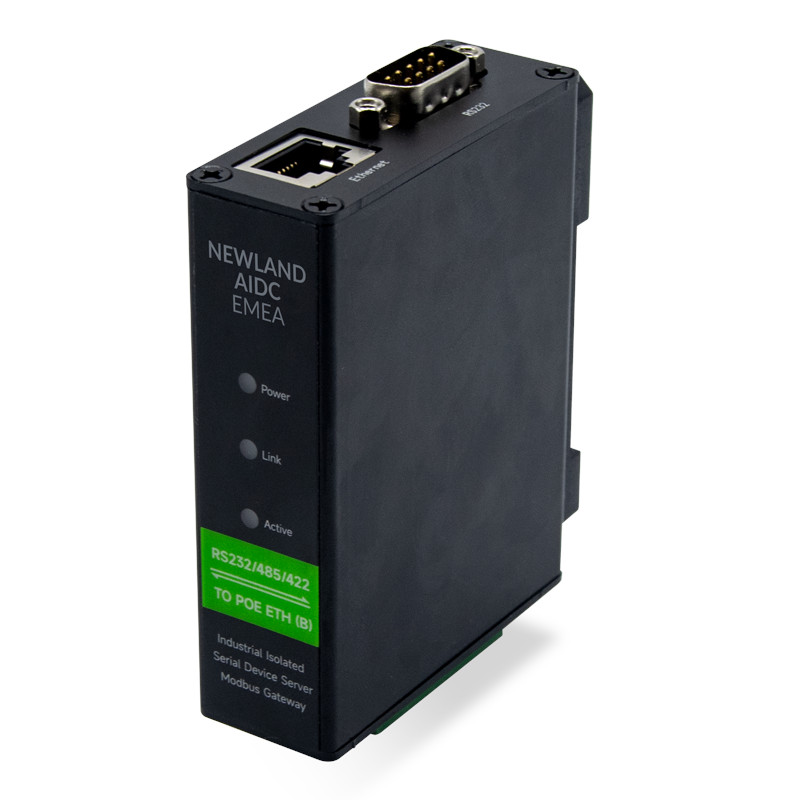
NLS-EX-232-01
Newland EX232 Remora serial port to Ethernet module with PoE. Compatible with all RS232 versions of HR, FM, FR and NVH scanners.PLN 434.72PLN 434.72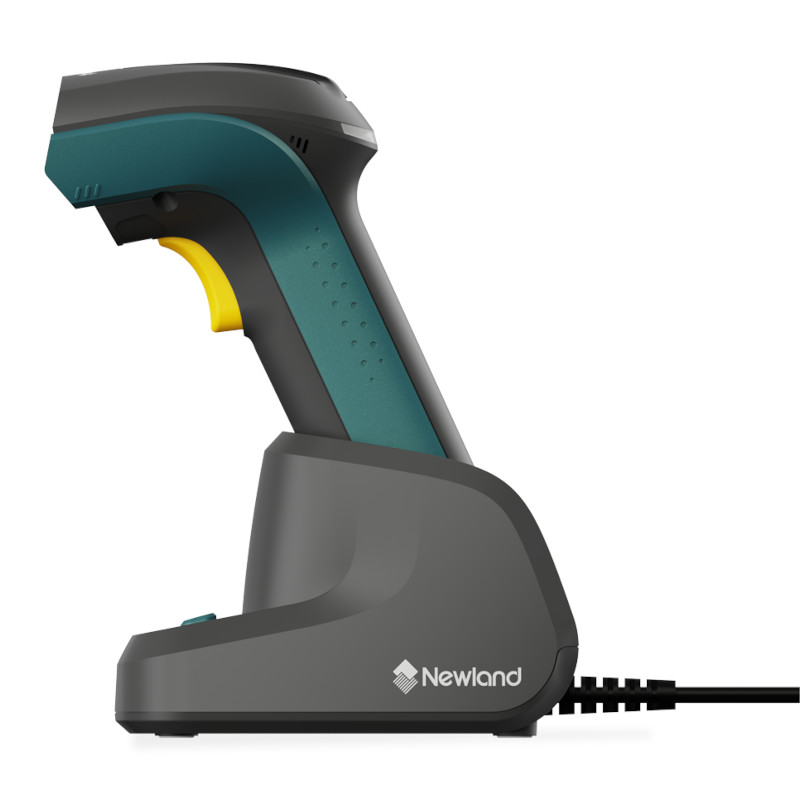
NLS-NVH220B-V2-XD
Newland NVH220 Lophius II Bluetooth barcode scanner, industrial, with 2D megapixel imager and AI-powered barcode detection and decoding. LED illumination: red, white, blue; vibration feedback. Connectivity: Bluetooth. Interfaces: RS232, USB, Ethernet. IP64 protection class, 1.8 m drop resistance. Incl.: docking station, USB cable.PLN 2,256.75PLN 2,256.75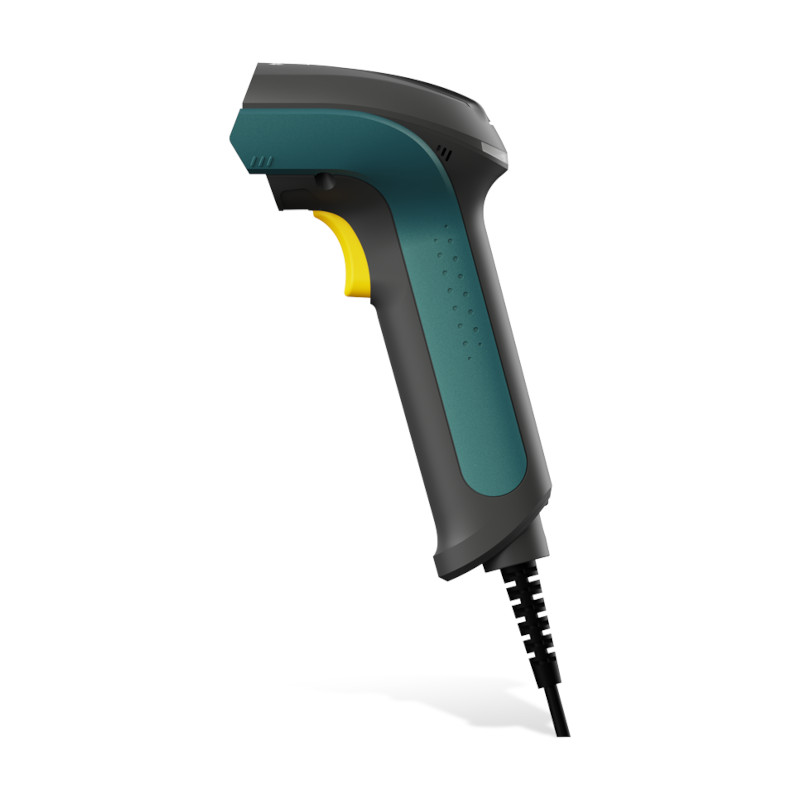
NLS-NVH220-V2-XD
Newland NVH220 Lophius II barcode scanner, industrial, with 2D megapixel imager and AI-powered barcode detection and decoding. LED illumination: red, white, blue; vibration feedback. Interfaces: RS232, USB, Ethernet. IP64 protection class, 1.8 m drop resistance. Incl.: 2 m straight rugged USB cable.
Most frequently asked questions
What is the difference between the corded and Bluetooth versions?
Scan engine, illumination, ruggedness and reading range are the same. The Bluetooth version has a battery, a docking station and up to 150 m radio range, and according to the datasheet also ModbusTCP, Profinet and MELSEC/SLMP. The corded version is lighter and has a 5-year warranty instead of 3.
Can it read a code marked on a metal part?
Yes. The scanner is designed for laser-etched and dot-peened DPM codes. On difficult surfaces the auto-learning button selects the illumination: red, blue or diffuse white.
How do I connect the scanner to a network or a PLC?
Both versions have Ethernet (TCP/IP), RS-232 and USB. According to the datasheet, the Bluetooth version also supports PLC protocols. An RS-232 scanner can be put on the network with the EX232 Remora converter, which mounts on a DIN rail and runs on PoE.
Is a service package worth buying?
Yes, for daily use on the shop floor. The package covers repair within 5 working days, wear of the window and trigger and accidental damage in normal use, which the standard warranty does not. Packages run for 3 or 5 years and are available for both versions.
Can it be used in a cold store?
The manufacturer specifies an operating range from −20 to 50°C. The Bluetooth version charges between 0 and 45°C, so the station must stand outside the cold zone.