- Home page
- WMS — Warehouse Management Sof...

WMS for warehouse, logistics and production — full integration with HDF MES
WMS — Warehouse Management Software
HDF WMS is a modern online warehouse management system covering every step of warehouse operations — from goods receipt, through storage and picking, to dispatch and shipping. The system integrates with ERP (SAP, Comarch ERP, Oracle, Microsoft Dynamics), data collectors and label printers.
Thanks to integration with HDF MES, it provides full support for production warehouses: raw material warehouses, work-in-process buffers and finished goods warehouses. The system supports FIFO/FEFO, batch identification and real-time material flow tracking.
Deployment typically takes 3–4 weeks. We offer a perpetual license with the option to expand the system as your company grows.
Thanks to integration with HDF MES, it provides full support for production warehouses: raw material warehouses, work-in-process buffers and finished goods warehouses. The system supports FIFO/FEFO, batch identification and real-time material flow tracking.
Deployment typically takes 3–4 weeks. We offer a perpetual license with the option to expand the system as your company grows.
Why HDF WMS
- Online WMS system
- 20 years of experience
- Deployment in 3–4 weeks
- Perpetual license
- Unlimited users
- SAP/Comarch/Oracle integration
- FIFO/FEFO support
- integration with HDF MES
- Handheld computers

Multilingual online warehouse system
that operates in a web browser. This allows you to control your warehouse from anywhere in the world, as long as you have access to a computer or any mobile device. HDF WMS integrates with ERP systems, scanners, data collectors, and barcode printers. This supports the daily work of operators and minimizes the risk of errors. With our system, you no longer have to worry about installing drivers, tedious updates, or complex setups. We ensure backward compatibility for data collectors and printers. You can use your trusted, existing automatic identification devices with Android, iOS, Windows, or Linux to work with our system.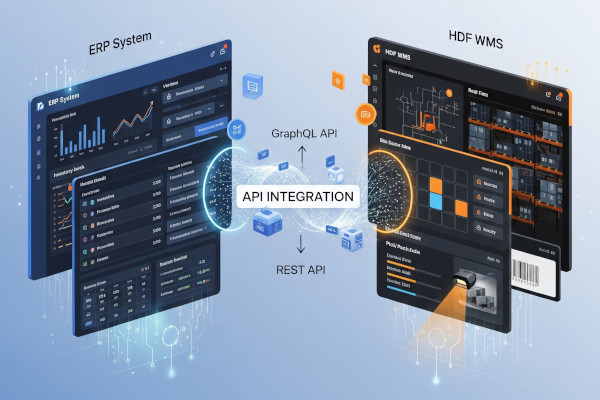
Advantages
One of the biggest advantages of HDF WMS is its full integration with other business systems. Our solution seamlessly exchanges data with popular ERP systems (SAP, Oracle, Microsoft Dynamics, Comarch ERP). We use REST API, GraphQL, and direct database links, ensuring a fast, secure, and reliable flow of information. This allows all departments within your company from logistics to sales and accounting, to work with the same, always-current data. HDF WMS also connects with courier company systems (DHL, UPS, DPD, InPost), enabling the automatic generation of shipping labels, parcel tracking, and returns management, which significantly shortens order handling times.
The HDF WMS system
automates warehouse operations, increasing their efficiency through key modules. It minimizes production downtime by automatically notifying about shortages via SMS/E-mail and generating KANBAN orders and supplier purchase orders. It eliminates errors and accelerates order picking by scanning and verifying the compliance of every barcode with the order before shipment. The system intelligently supports inventory rotation, automatically suggesting the retrieval of products with the shortest expiration date (FIFO), which is crucial in regulated industries. It also allows for the real-time generation of logistics labels (compliant with GS1 standards) on popular printers. Thanks to cooperation with barcode data collectors, you can quickly execute all key warehouse operations (Goods Receipt, Goods Issue, inventory). Additionally, the system's multilingual capability ensures effective work for operators from various countries and 3PL entities.Dedicated WMS System for the Warehouse – Discover its Advantages
You are just one step away from implementing warehouse logistics based on barcodes! Check what you gain with our WMS program for warehouse management.
- 01
Work Optimization
The WMS system guarantees work optimization and precise item location. Comprehensive warehouse management is achieved by issuing effective commands and tasks to employees, which ultimately leads to an increase in overall operational efficiency. Crucially, every product is assigned a correct, permanent location, minimizing the risk of picking the wrong item, while the route-finding module automatically shortens order fulfillment time by suggesting the fastest retrieval path. - 02
Automation
A key advantage is automation, which is integrated with rigorous quality control and order picking. The system ensures process acceleration from goods registration through picking to final issue, guaranteeing the fast delivery of the article to the customer. The picking function involves scanning and verifying the item's compliance with the order list, which is further validated by the quality control module before final shipment. This meticulous process provides the client with the assurance that the goods are accurate and error-free. - 03
Full mobility and industrial device support
HDF WMS stands out due to full mobility and support for industrial devices. The online operation mode allows for warehouse management and monitoring from any location worldwide using any internet-connected device. The system is fully compatible with barcode terminals (data collectors) and industrial tablets, significantly increasing operator comfort and task accuracy, including specialized support for forklift operators (e.g., displaying retrieval locations). This mobility and precision greatly streamlines internal logistics and eliminates errors. - 04
Flow control (Traceability)
The system significantly facilitates inventory taking and ensures comprehensive flow control (Traceability). Due to continuous inventory status updates, stocktaking becomes faster, simpler, and more reliable than traditional methods. The Traceability function enables precise tracking of every item's movement history, which is essential for handling complaints and product quality verification. Additionally, the system supports expiration date control, automatically suggesting that products with the shortest shelf life be picked first (FIFO).
Benefits of implementing HDF WMS
Implementing HDF WMS is an investment that translates into measurable savings and improved quality of warehouse processes:
- Higher operational efficiency: Automation of receiving, picking, and shipping processes shortens order fulfillment times.
- Cost and loss reduction: Fewer errors, better utilization of warehouse space, and inventory stock control.
- Better customer service: Faster and more accurate fulfillment of warehouse orders increases customer satisfaction.
- Full warehouse control: Real-time monitoring of stock levels, goods movements, and order fulfillment allows managers to make business decisions based on real data.
- System scalability: HDF WMS grows with your company. We can adapt each module to the needs of logistics warehouses, 3PL operators, and production.
Technology and implementation
HDF WMS was designed with ease of implementation and cloud operation in mind:
- Online accessibility: The system works in Chrome, Firefox, and Edge browsers, and its operation does not require specialized hardware, operating systems, or software.
- Cloud or on-premises implementation: The system can be installed on the client's servers or in the cloud of global operators (Google Cloud, AWS, Microsoft Azure).
- Technical support: HDF Software will handle the entire installation, configuration, and provide ongoing support for the system's operation.
- Data security: All operations are encrypted, and access to data is controlled by user permissions, ensuring full protection of sensitive information.
Cost of the WMS system
We sell HDF WMS under a perpetual license model — no subscription, no per-user fees. This is one of the key differences from SaaS systems: you pay once, and the system becomes your property and grows with your company.
- Perpetual license: a one-time purchase with full control over the system. It covers unlimited users and up to 100 concurrent connections as standard. For large warehouses and 3PL operators, an option for an unlimited number of concurrent workstations is available.
- Modular pricing: you pay only for the features you actually need. We build the system from ready-made modules (receiving, storage, picking, shipping, traceability, MES, ERP, courier integrations, KANBAN) and tailor the scope to your warehouse processes.
- Implementation: priced individually depending on the scope of ERP integration and the number of modules. Typically 3–4 weeks.
- Future expansion: additional modules can be purchased at any time.
Why HDF WMS?
HDF WMS is not just warehouse software; it is a comprehensive solution that supports company growth:
- Modular design: Allows for adapting the system's functions to the individual needs of a warehouse or 3PL operator.
- Seamless integration: Smooth collaboration with ERP, printers using ZPL II (Zebra Programming Language), data collectors, and courier company systems.
- Professional support: Free selection of devices and assistance with their configuration, along with technical support at every stage of system implementation and use.
- Security and reliability: The system monitors all warehouse operations, ensuring the secure storage of all data.
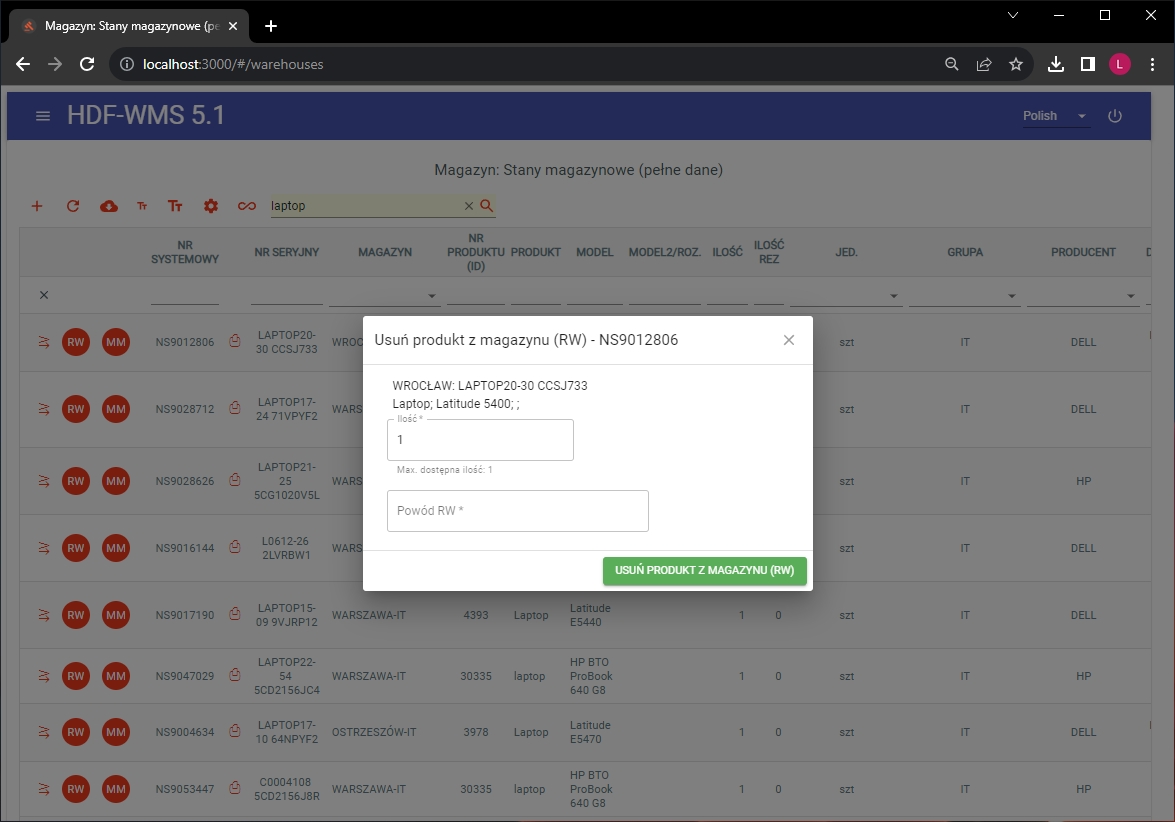
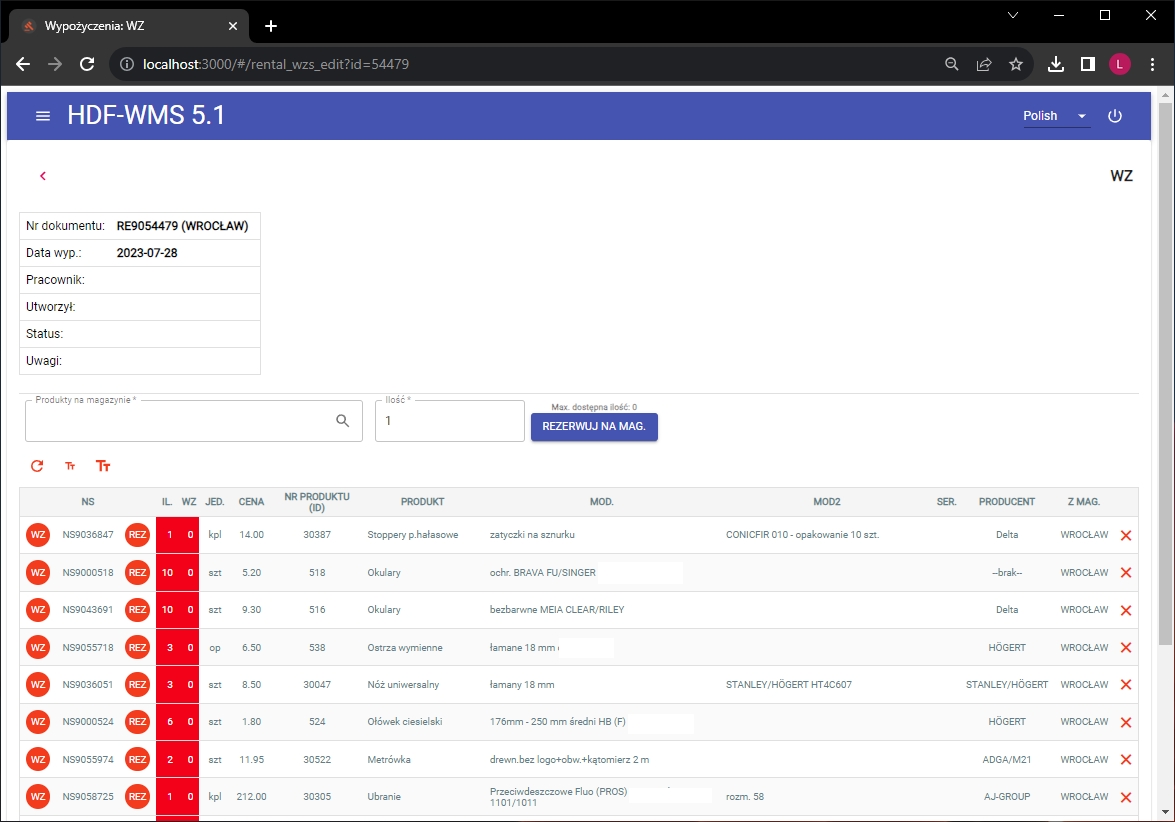
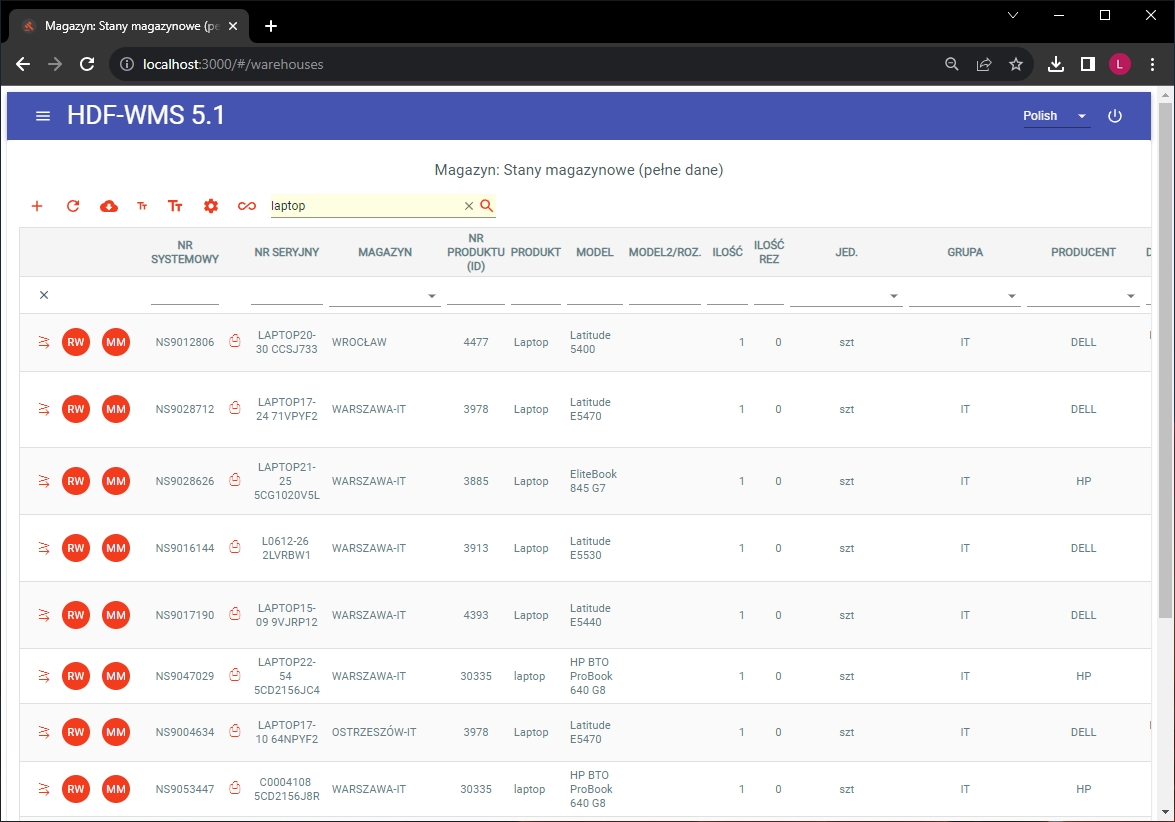
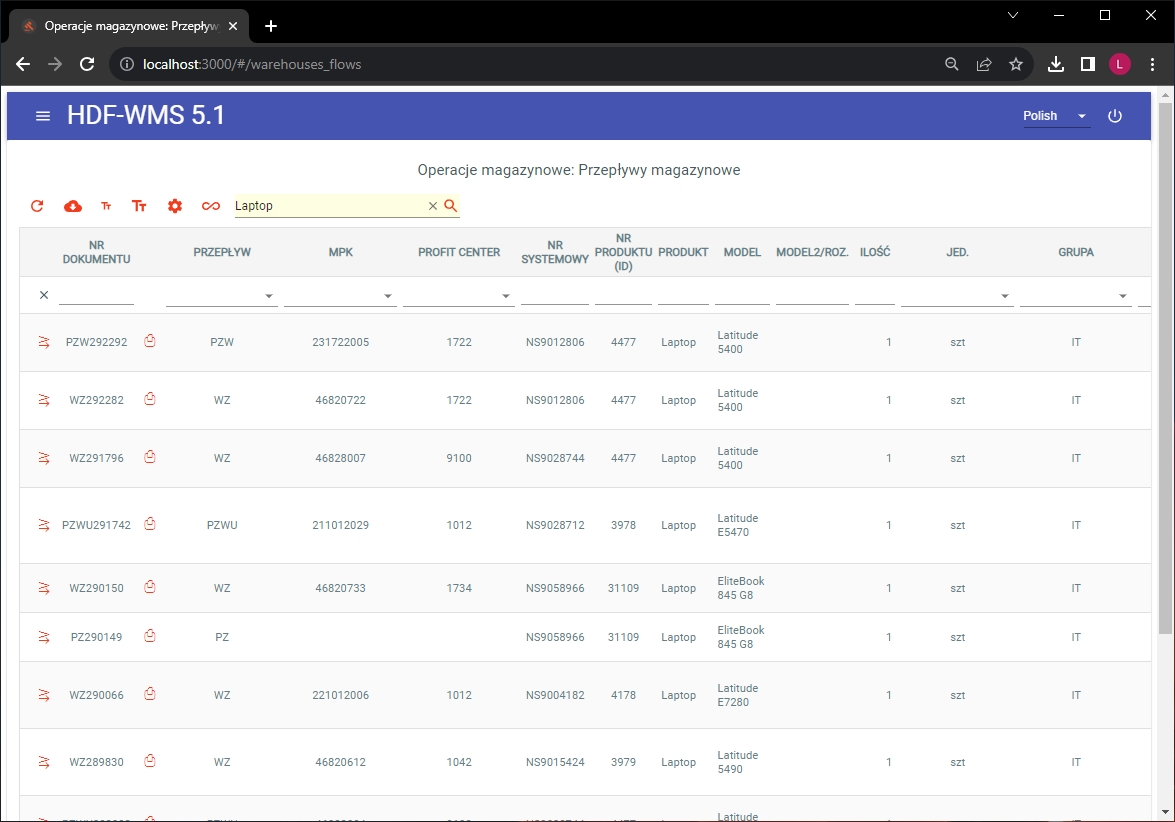
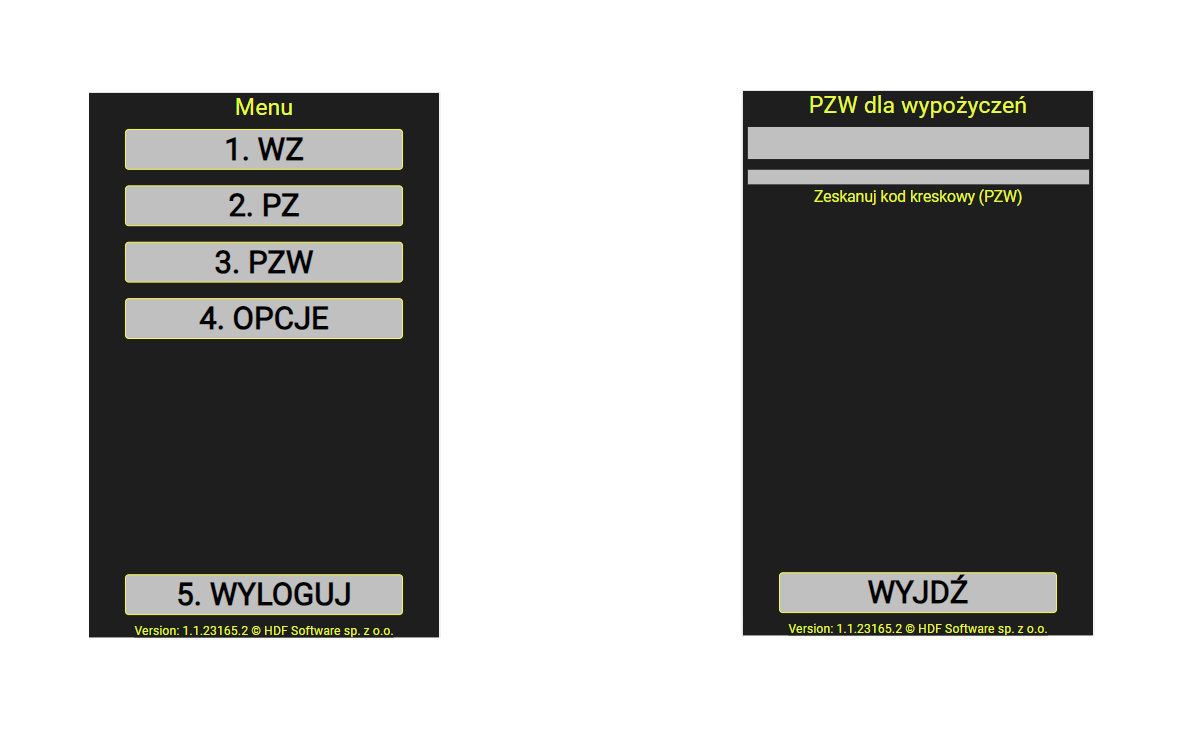
Screenshots of our WMS System
A little bit of theory
What is a WMS system?
A WMS (Warehouse Management System) is software designed to manage the flow of goods within a warehouse. It monitors every event from goods receipt to dispatch, shortening order fulfillment times and minimizing the risk of errors. This gives your company greater control over logistics and enhances the quality of customer service.
How does a WMS system work?
A WMS system automates and coordinates every stage of warehouse operations: receiving, storage, order picking, and shipping. The system operates in real-time, so all operations are immediately visible to employees, managers, and external systems. This ensures process transparency and enables faster business decisions.
Most frequently asked questions
How long does it take to implement HDF WMS in a warehouse?
HDF WMS implementation typically takes 3–4 weeks. The duration depends on warehouse size and the scope of ERP integration. Implementation includes system configuration, integration with ERP and courier services, employee training, and functional testing. Large logistics centers with multiple integrations may require 6–12 weeks.
Do you need specialized equipment to work with HDF WMS?
No. The system works in a web browser, but for full efficiency, we recommend using barcode scanners, label printers, and data collectors. This allows operators to verify goods in real-time without paper documentation.
How does goods tracking work in HDF WMS?
HDF WMS tracks goods by assigning batch numbers, series numbers, and serial numbers to every warehouse operation. Each movement — receiving, transfer, picking, shipping — is recorded in real time with location and operator. This makes it possible to reconstruct the complete history of any item: from supplier, through the warehouse, to the end customer (traceability).
How does HDF WMS integrate with ERP and courier systems?
HDF WMS integrates with ERP systems (SAP, Oracle, Microsoft Dynamics, Comarch) and courier companies (DHL, UPS, DPD, InPost) through REST API, GraphQL, or direct database connections. The integration enables automatic generation of warehouse documents, real-time stock synchronization, and parcel monitoring.
How to choose a WMS system?
When choosing a WMS system, check five criteria: 1) modularity — whether the system can be expanded with new features as your company grows, 2) integrations — whether it connects to your ERP, courier services, data collectors, and printers, 3) technical limits — number of users and concurrent connections, 4) license model — perpetual vs SaaS, 5) vendor experience — number of implementations, years on the market, availability of technical support. A good WMS grows with the company and does not require replacement after 5 years.
What industries is HDF WMS best for?
The system is versatile and ideal for: logistics operators and 3PL warehouses, distribution warehouses, manufacturing companies, and the food, pharmaceutical, and industrial sectors. HDF WMS supports both complex warehouse operations and daily logistics processes, ensuring full control and work optimization.
Does HDF WMS work in the cloud?
Yes. HDF WMS runs online in a web browser (Chrome, Firefox, Edge) — with no need to install applications on employees' computers. The system can be installed on the client's servers or in the cloud of global providers (Google Cloud, AWS, Microsoft Azure). Warehouse operators, data collectors, tablets, and printers connect over the internet in real time.
Does HDF WMS work with HDF MES?
Yes. HDF WMS has been designed from the start as a system compatible with HDF MES — our manufacturing execution system. The integration covers: raw material warehouses (automatic picking based on the production plan), work-in-process buffers, finished goods warehouses (receiving from the production line with batch numbers and GS1 labels), and Kanban between the warehouse and production stations. Companies that implement WMS together with MES gain a single source of truth about stock levels and full traceability from raw material to finished product to customer.
How much does a WMS system cost?
The cost of HDF WMS consists of four elements: a perpetual license (priced individually based on warehouse size and selected modules), implementation (configuration, integrations, training — 3–4 weeks), monthly technical support in ESSENTIAL or PREMIUM packages, and optionally hardware (data collectors, printers, scanners). We sell under a perpetual license model — no subscription. The standard license includes unlimited users and up to 100 concurrent connections.
What is REST API?
REST API is a programming interface that allows applications to exchange data over the internet using the HTTP protocol. It works on a client-server basis and uses standard methods (GET, POST, PUT, DELETE) to retrieve, add, update, and delete data. In the context of HDF WMS, it is the standard way to integrate the system with your ERP, online store, or courier system — without manual data copying.
What is GraphQL?
GraphQL is a data query language developed by Facebook (now Meta), allowing applications to fetch exactly the data they need — in a single query instead of the multiple calls typical of REST API. In the context of HDF WMS, it is a modern alternative to REST API: faster integration with external systems and reduced network load, especially for complex queries (e.g. retrieving the history of a goods batch with multiple levels of detail).
Get in touch
Have questions about our products or need a tailored offer? Get in touch — we’ll be happy to advise you and help find the right solution for your needs.