Barcode scanners
We match barcode scanners to HDF WMS and HDF MES workstations and deployments, also in a kit with the Bilberry xT micro-kiosk.
Manufacturer:
 Newland
Newland HR33 Marlin AI
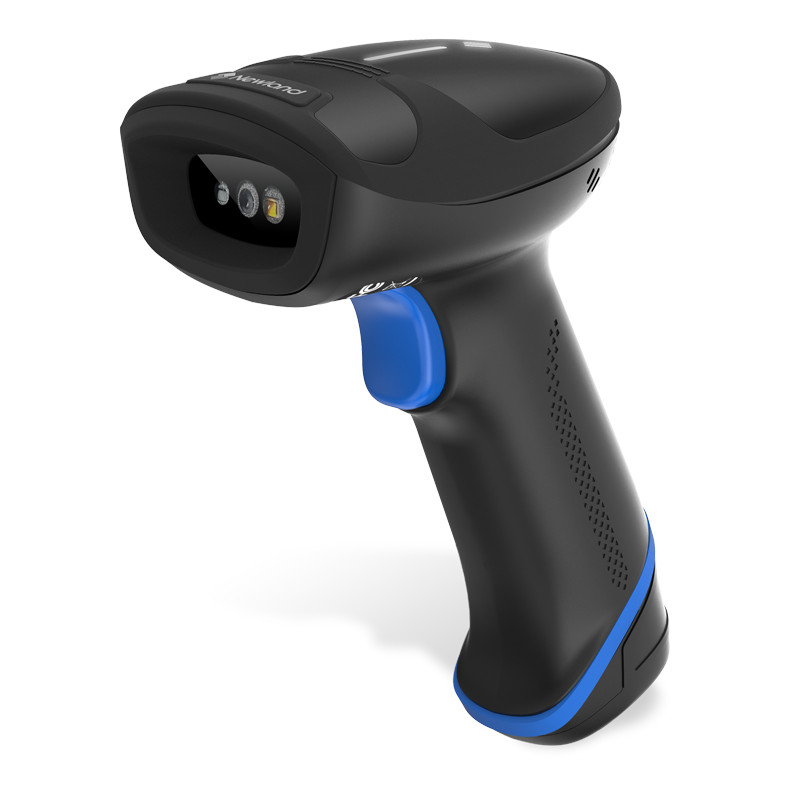
Newland HR33 Marlin AI is a handheld 1D and 2D barcode scanner for production, warehouse and packing stations. It succeeds the HR33 Marlin and is a bestseller among Newland scanners. It comes in two models with the same scan engine and the same dimensions: HR33 Marlin AI Corded works over a USB or RS-232 cable, while HR33 Marlin AI Bluetooth connects wirelessly to its cradle and has a swappable battery. 1280 × 800 pixel sensor and AI-Powered Barcode Detection: the scanner reads 1D and 2D codes, including DotCode and Digimarc, from 3 mil density and 15% print contrast. According to the manufacturer it also handles damaged and distorted codes and codes on reflective and curved surfaces. Laser aimer and Acuscan: when several codes sit next to each other on a label, one trigger press reads the one the aimer points at. The operator does not have to cover neighbouring codes by hand or scan twice. Reading range from a few centimetres to over 50 cm: EAN-13 (13 mil) is read from 3.5 to 53.5 cm and Data Matrix (10 mil) from 2 to 24.5 cm. That covers work at a bench, a conveyor and a pallet next to the station. IP52 and 1.8 m drops to concrete: the scanner withstands dust, dripping water and a drop from the hand or the bench. It operates from −20 to 50°C, so also in an unheated hall. 5-year manufacturer warranty: longer than the typical replacement cycle of station equipment, so repair costs over that period are predictable. Lua scripts (Advanced Scripting) and the EasySet tool: scan data can be processed inside the scanner, e.g. cutting out part of a code or adding a prefix, with no changes in the system that receives it. Scan confirmation by beep, LED and vibration: in a noisy hall the operator feels a good read in the hand and does not need to look at the screen. Cable or Bluetooth. The corded model weighs 140 g, is powered from the port and needs no charging, which suits a fixed station. Choose the Bluetooth model (210 g) when the operator walks from the computer to a pallet, machine or rack: the manufacturer states a range of at least 100 m in open space, and the cradle charges the scanner and links it to the computer over USB. Interface. Both models work over USB as a keyboard, a virtual serial port or HID-POS. Only the corded model is also available with an RS-232 cable and power adapter. That is the variant for machine controllers, scales and older devices without a USB port. Stand. The corded model can be ordered with an adjustable stand that moves from upright to flat, on a desk or on a wall. The Bluetooth model always ships with a charging cradle. Battery and shift work. The 2600 mAh battery in the Bluetooth model lasts, according to the manufacturer, at least 15 hours at one scan every 6 seconds and charges in up to 6 hours. It is replaced without tools, and a two-colour indicator warns of a low charge. Working out of range. The Bluetooth model can store scans in memory (at least 16,384 codes) and send them once it is back in range of the cradle. Spare batteries and a four-battery charger are available for the Bluetooth model, useful in multi-shift work. For the corded model you can add an adjustable stand, an RS-232 cable with power adapter or a USB cable. Both models fit a wall mount clip that gives the scanner a fixed place at the station.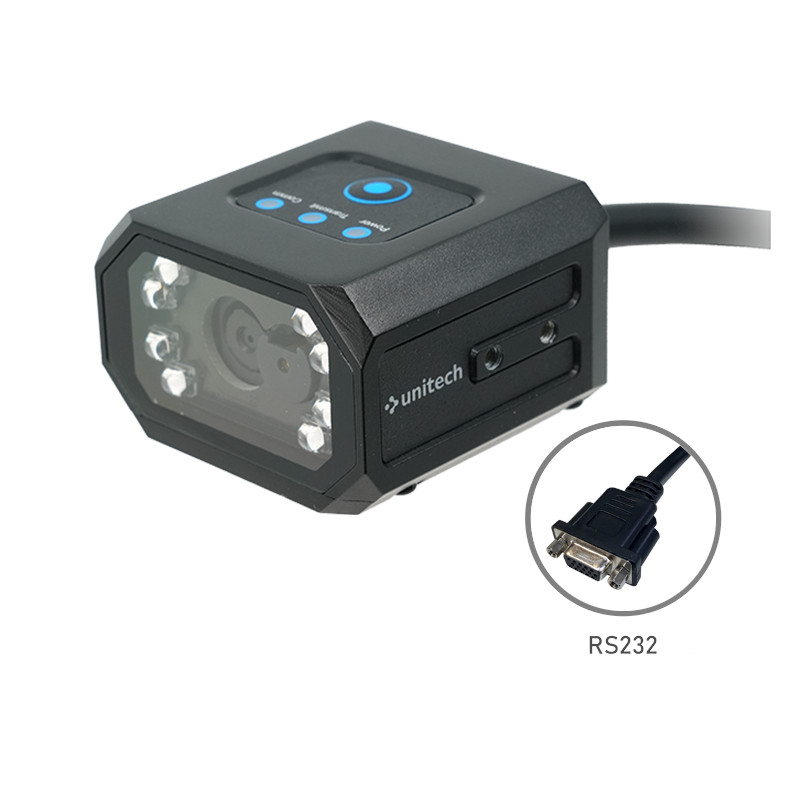 Unitech
Unitech FC80
Unitech FC80 is a compact fixed-mount barcode scanner for production lines, conveyors and packing stations. It reads 1D and 2D codes on labels as well as DPM codes (Data Matrix and QR) that are laser etched, dot peened or inkjet printed directly on metal and plastic. It sends the result over Ethernet or RS232, including the Profinet, Modbus TCP and EtherNet/IP automation protocols, so it can talk directly to a PLC. It reads automatically, with no operator involved: mounted above a roller conveyor, it captures the code of every item passing under its window. DPM reading: reads Data Matrix and QR codes marked directly on parts, including low-contrast codes on textured and curved surfaces. Parts can be identified throughout the process without a label that could peel off or get damaged. 1920 × 800 pixel sensor, 60 frames per second: the wide field of view (52° horizontal, 23° vertical) helps when parts do not always stop in exactly the same place. Ethernet (TCP/IP, Profinet, Modbus TCP, EtherNet/IP) and RS232: the scanner connects to the plant network and directly to the controller, with no PC in between. The serial port also lets you connect it to older machines. 45 × 47 × 30 mm, 133 g: fits tight spaces next to a conveyor or inside a machine enclosure. It is installed on a dedicated mounting bracket. Trigger and presentation modes: the scanner reads on demand after a trigger signal, or works hands-free and reads a code presented in front of its window. IP54 housing, multiple 1.2 m drops: protected against dust and water splashes. Operates from −10 to 50°C at up to 85% non-condensing humidity. Reads in ambient light up to 100,000 lux: works under strong shop-floor lighting. Connection. Choose Profinet, Modbus TCP or EtherNet/IP when the read should go straight to the line controller. TCP/IP is enough when an application on a PC or server receives the data. RS232 is for machines without a network. The scanner has no USB port. Reading distance. Match it to the code size: 10 mil Data Matrix reads from 5.5 to 27.5 cm, 20 mil Data Matrix from 5 to 56 cm, and 15 mil Code 128 from 5 to 68 cm. Small codes such as 4 mil Code 39 need 6 to 16 cm. Operating mode. Trigger mode suits conveyors where the read has to happen at a defined moment. Presentation mode suits stations where the operator holds a part or carton up to the scanner. Power. The scanner runs on 24 V DC. The manufacturer offers a 24 V / 2.5 A power supply, a 3 m Ethernet cable and 2 m and 3 m RS232 cables.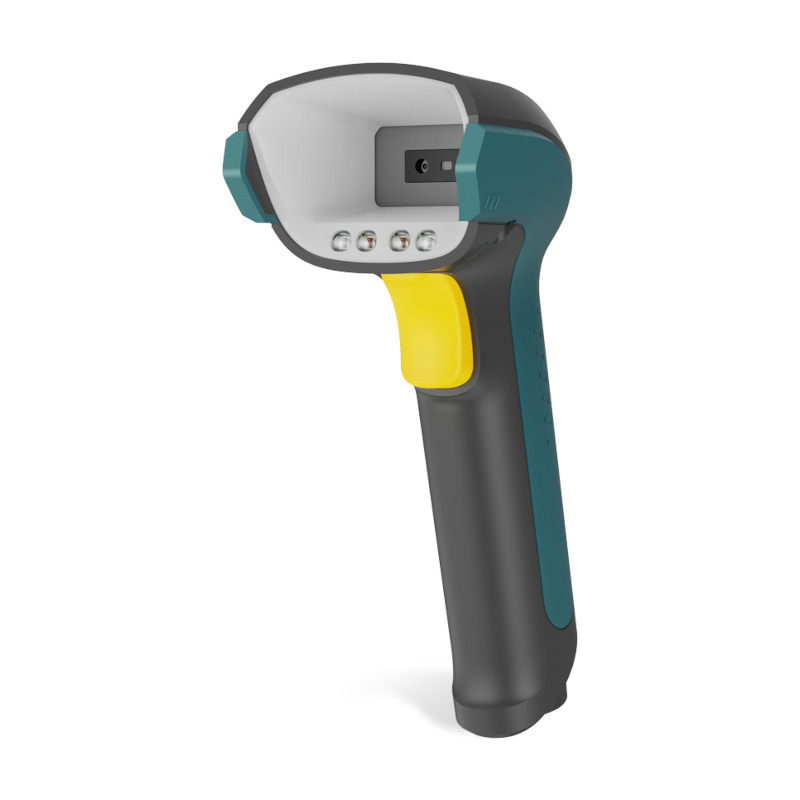 Newland NVH220 Lophius AI is an industrial 2D handheld scanner for direct part marking (DPM): codes laser-etched or dot-peened on metal, plastic and curved surfaces. It fits production workstations, quality control and warehouses, wherever barcodes are damaged, distorted or printed on shiny surfaces. Both versions share the same housing, image sensor, illumination and ruggedness. They differ in how they connect: NVH220 is corded, while NVH220 Bluetooth has a battery and a docking station. 1280 × 800 image sensor and DPM decoding: reads laser-etched and dot-peened codes as well as damaged or distorted 1D and 2D barcodes (Data Matrix, QR, Micro QR, PDF417, Aztec). It is GS1 Ready, so it handles GS1-128 and GS1 DataMatrix codes on logistics labels. Three illumination types with auto-learning: direct red and blue light plus diffuse white light. A button on top of the housing starts automatic adjustment of brightness and light source to the material: reflective, curved and low-contrast surfaces and colored codes. Cross laser aimer and wide scan angles: ±50° pitch and skew, 360° roll. Operators do not have to line up the part so the code faces the scanner head-on. Close-range reading: EAN-13 from 15 to 220 mm, QR codes (20 mil) up to 225 mm, small 2D codes (10 mil) up to 160 mm. IP64, 1.8 m drops, operation from −20 to 50°C: withstands dust, water splashes and drops at the workstation. ESD protection is ±16 kV air and ±8 kV contact discharge. USB, RS-232 and Ethernet in both versions: connects to a PC, an operator panel or directly to the network (TCP/IP). According to the datasheet, the Bluetooth version also supports the industrial protocols ModbusTCP, Profinet and MELSEC/SLMP, so scans can go to a PLC. Bluetooth 5.0 and a battery for more than two shifts: up to 150 m range in open space, more than 17 hours of continuous use or up to 60,000 scans per charge, 3-hour charging (Bluetooth version). Beep, LED and vibration feedback: operators know the scan succeeded even in a noisy hall. Configuration with the free EasySet software. Connection. The corded version suits a fixed workstation: no charging and a lighter device (160 g without cable). Choose Bluetooth when the operator moves between workstations, racks or the loading dock. It weighs 218 g with the battery, and the docking station is included. The station is rated IP42, so place it in a sheltered spot. The battery charges between 0 and 45°C. Automation integration. If scans must go straight to a PLC (Profinet, ModbusTCP, MELSEC/SLMP), the datasheet lists these protocols for the Bluetooth version only. A scanner connected via RS-232 can be put on the network with the Newland EX232 Remora converter. It converts RS-232 to Ethernet, powers the scanner via PoE or a 6–31 V supply and mounts on a DIN rail in a control cabinet. It has power and signal isolation and two-way communication, so the system can also send commands back to the scanner. Warranty and service. The corded version has a 5-year warranty, the Bluetooth version 3 years, extendable to 5. Manufacturer service packages for 3 or 5 years are available for both. They cover repair within 5 working days, wear and tear (scratched window, worn trigger, charging contacts) and accidental damage in normal use, such as a cracked housing. For scanners used every day on the shop floor, it is worth adding a package with the device.
 Datalogic
Datalogic PowerScan 9600
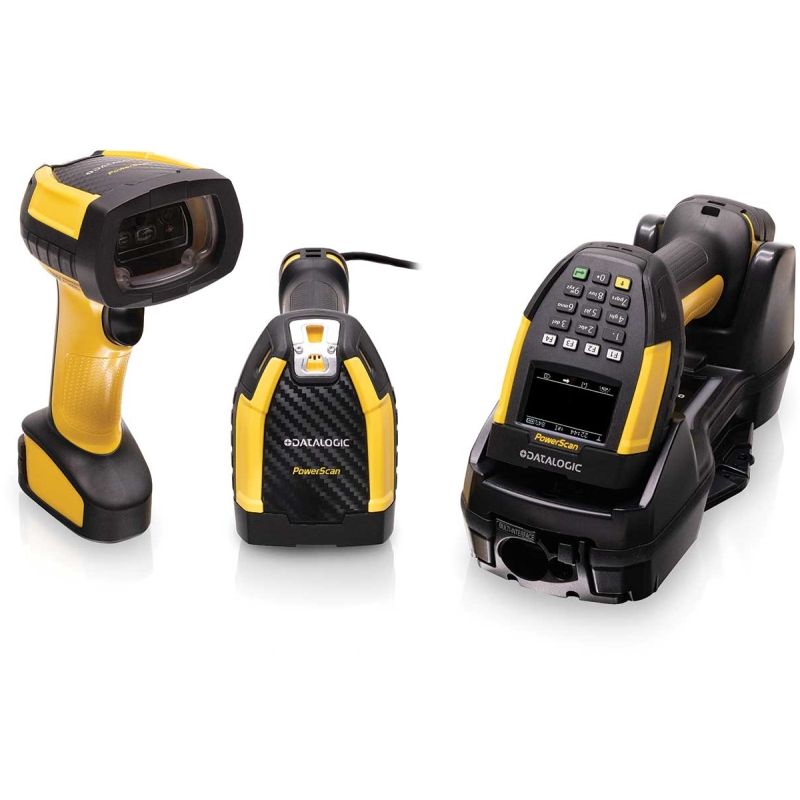
Datalogic PowerScan 9600 is a series of industrial 1D and 2D barcode scanners for production halls, warehouses and cold stores. It is the top line in the PowerScan family from Datalogic, an Italian company based in Bologna, recognisable by its yellow and black housing. The scanner withstands 2.5 m drops onto concrete, dust, water and washing, and the trigger is rated for 10 million presses. The series includes a corded version, two cordless versions and several optics, from standard, through reading from 20 m, to DPM codes marked directly on parts. 2.5 m drops onto concrete, IP65 and IP67 sealing: the scanner keeps working after falling from a workstation or a forklift, after dust and after washing. Operation from −30°C for the corded version, from −20°C for cordless, up to +50°C: for cold stores, unheated warehouses and loading docks. Three connection options: the corded PD9630, the cordless PBT9600 with Bluetooth 5.0 (up to 100 m range) and the PM9600 with the Datalogic STAR radio system (up to 150 m range, many scanners on one base station). 3350 mAh Li-ion battery for more than 80,000 reads: on cordless versions one charge lasts several shifts. The battery charges inductively in the cradle, with no contacts to wear out. Green Spot indicator: a green spot projected onto the code confirms a good read, which helps in noisy halls. USB, RS-232, Ethernet, EtherNet/IP and Profinet: connect the scanner to a PC, a mobile computer or directly to the machine network on the line. Versions with display and keypad: on cordless models the operator sees a confirmation or message from the system and can enter a quantity without walking to the PC. 3-year manufacturer warranty: standard on a scanner built for intensive use. Corded or cordless. PD9630 for a fixed production workstation and the lowest temperatures. PBT9600 with Bluetooth to connect to a PC, tablet or mobile computer. PM9600 with the STAR system when several scanners work in the hall and a longer range is needed. Optics. SR for typical labels at close range. HP for dense and small codes with a wider distance range. AR (Auto Range) reads from 3 cm to more than 20 m, so it suits forklifts and high racks. DC has a colour sensor for capturing documents and signatures. DPX reads DPM codes that are dot-peened, engraved or laser-marked on parts. Display and keypad. Worth choosing when the scanner is to act as a simple terminal, for example to confirm quantities on a forklift. Workstation without a PC. The scanner can be connected to our Bilberry xT micro kiosk, which guides the operator through the process at the production workstation and sends data to the system. We supply the PowerScan 9600 as part of a workstation: on the production line in HDF MES, on a forklift in HDF WMS or together with the Bilberry xT micro kiosk. We configure the scanner for the application, set up communication and train operators, so the workstation works in the process right after deployment.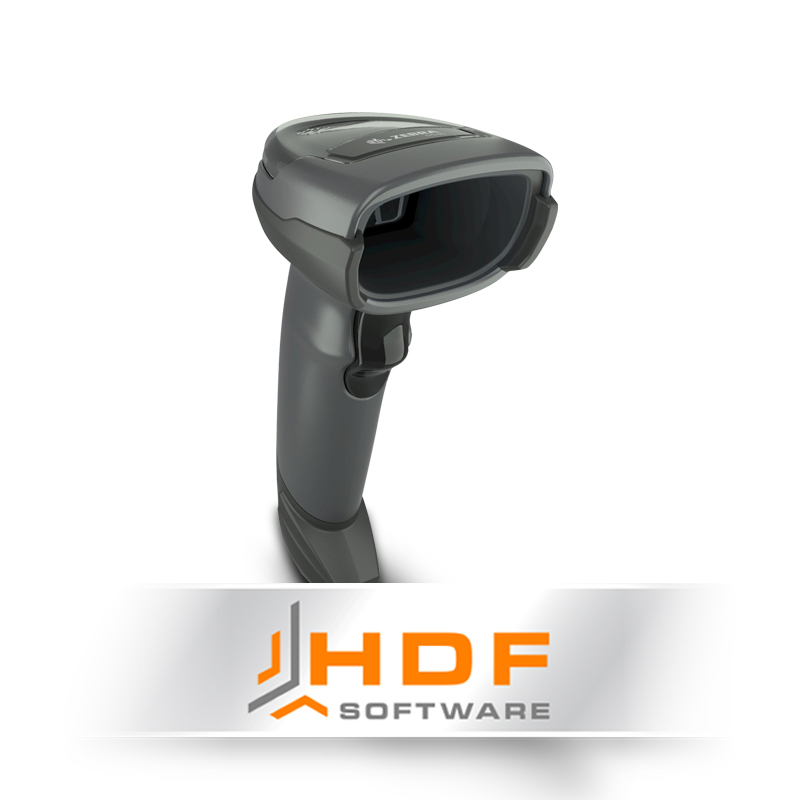 Zebra DS4608 and DS4678 are handheld 1D and 2D barcode scanners from the DS4600 series for workstations: goods receipt and issue in the warehouse, packing, offices, checkouts and production stations. The DS4608 is corded, while the DS4678 connects over Bluetooth and charges in a cradle, so the operator can walk up to a pallet or machine with the scanner. Both share the same sensor and read codes from labels, including damaged and poorly printed ones, and from phone screens. The DPE versions also read DPM codes, marked directly on parts. The DS4608 is the successor to the DS4308. 1280 × 800 pixel sensor and PRZM technology: the scanner handles dense, damaged and low-contrast barcodes. A good read is confirmed by illuminating the barcode, by LEDs and by a beep. SR and HD optics: SR reads an EAN code from up to about 71 cm and HD from up to about 46 cm, but HD reads smaller codes, for example 4 mil Data Matrix instead of 5 mil. Range depends on print quality, contrast and ambient light. DPE version for DPM codes: white illumination with a diffuser and a green aimer read small laser-marked codes on plastic and metal, including shiny surfaces, as well as ink-printed and chemically etched codes. A read is also confirmed by vibration, useful in a noisy hall. 1.8 m drops to concrete and IP52 sealing: the scanner survives everyday drops from the workstation and dust. The manufacturer also specifies 2000 tumbles from 0.5 m. Handheld and presentation mode: placed on a stand or in the presentation cradle, the scanner scans automatically, leaving both hands free for receiving goods or packing. DS4678: 2500 mAh battery and Bluetooth 5.2: according to the manufacturer one charge covers 50,000 scans, more than 13 hours at one scan per second. Radio range reaches up to 100 m, and Virtual Tether alerts when the scanner goes out of range or is not returned to the cradle. USB, RS-232, keyboard wedge and IBM 46XX (RS-485): auto-host-detect cables set the scanner up for a PC, mobile computer or POS without manual configuration. Settings are loaded with the 123Scan tool. Multiple codes in one scan: the scanner captures several codes from a label at once and passes only the required ones to the system, in a set order. Label Parse+ splits GS1 label data into fields. FeatureDS4608DS4678ConnectioncableBluetooth 5.2, corded cradleOptics versionsSR, HD, DPESR, DPEPowerfrom the host port or a power supplyreplaceable 2500 mAh batteryFreedom of movementcable lengthup to 100 m from the cradleWeight162 g225 gColorblack or whiteblackManufacturer warranty5 years3 years Corded or Bluetooth. The DS4608 is enough for a fixed workstation where goods come to the scanner. Choose the DS4678 when the operator walks up to pallets, large cartons or machines. SR, HD or DPE. SR is enough for logistics and product labels and on-screen codes. Choose HD for very small, dense codes; this optics version is corded only. DPE is for codes marked directly on parts, for example laser marks on circuit boards and electronic components. The manufacturer positions it for electronics and light manufacturing, including clean rooms; the same scanner also reads regular carton labels. Kit. Some variants are the scanner only, without a cable or cradle, and some are kits: the DS4608 with a USB cable and optionally a stand, the DS4678 with a USB cable and a standard or presentation cradle. For a first workstation a kit is more convenient. Interface. USB is enough with a PC or mobile computer. RS-232 and IBM 46XX help with POS terminals and older devices without USB. For the DPE versions the manufacturer lists USB, RS-232 and IBM 46XX, without keyboard wedge. EAS. Variants with EAS work with checkout EAS deactivation systems and matter only in a store. When to choose another device. When the worker scans on the move across the warehouse and needs a screen, a mobile computer with a built-in scanner is a better choice.
 Datalogic
Datalogic QuickScan QD2590
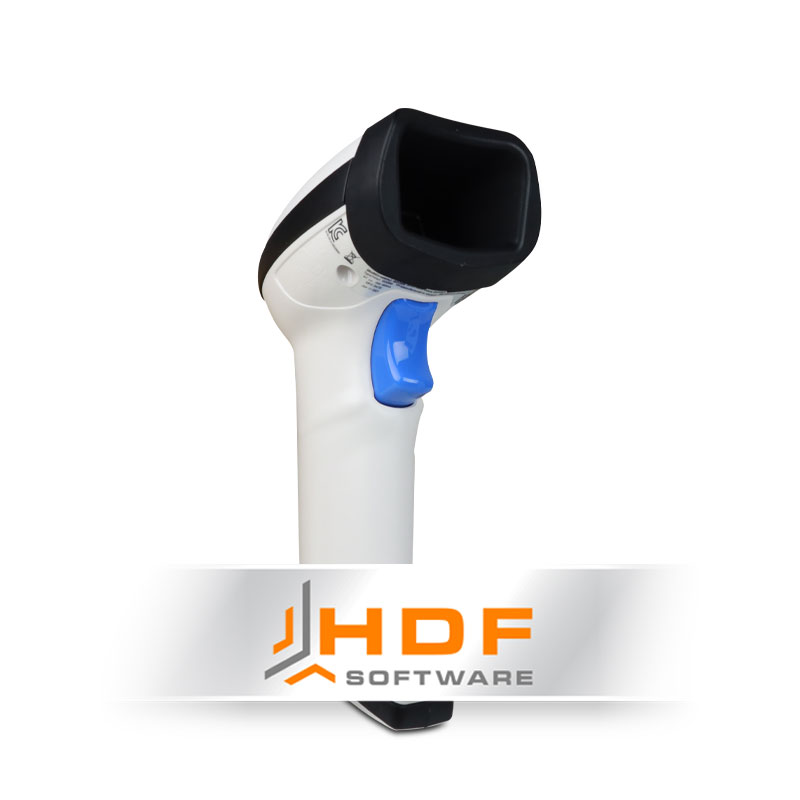
Datalogic QuickScan QD2590 is a corded 1D and 2D barcode scanner for everyday work at a desk, counter, packing station or label printing station. It reads codes from labels, documents and smartphone screens, and scans at any angle, without lining up the code with the scanner. It is a simple, proven model from Datalogic, an Italian company based in Bologna, with a five-year manufacturer warranty. It belongs to the QuickScan 2500 series, which also includes cordless versions. Omnidirectional 2D imager: 1D and 2D codes, including QR Code, Data Matrix, postal and stacked codes. The operator does not have to turn the product or document. Reading from smartphone screens: codes from apps, emails and tickets are scanned just like from paper. Aiming with two blue triangles and Green Spot indicator: the triangles show where the scanner aims, and a green spot on the code confirms a good read. 1.5 m drops onto concrete, IP52, trigger rated for 10 million presses: the scanner survives a fall from the desk and daily intensive work. USB, USB-C, RS-232 and Keyboard Wedge: depending on the version. Connected via USB, the scanner works like a keyboard, so the code goes into any field in a program without installing drivers. Black and white versions, kits with cable and stand: a stand allows scanning without holding the scanner, for example at a packing station. 5-year manufacturer warranty: long coverage for a scanner in this price class. The QD2590 is a general-purpose scanner. It works well at a label printing station, at a goods receipt desk, in offices handling documents, at a service counter and when packing shipments. Anywhere the operator scans codes at close range and does not need an industrial scanner. It is not a scanner for cold stores or outdoor work: it operates from 0 to +50°C, and IP52 sealing only protects against dust and dripping water. For production halls, forklift warehouses and low temperatures, choose an industrial scanner. With or without a stand. Choose a kit with a stand when the operator scans many items held up to the scanner. The scanner with a cable is enough for occasional scanning. Interface. The USB version is enough for a PC and most POS systems. Choose the multi-interface version when the scanner must work with older equipment over RS-232. Corded or cordless. If the operator walks away from the station, for example to a pallet or rack, consider the cordless version from the same series. Colour. The white housing suits bright offices and service points, the black one suits workstations. We supply the QD2590 together with the workstation: with a label printer and HDF Labels, or with a PC in the goods receipt and dispatch process. We configure the scanner for the application, so from day one it scans into the right field in the right format.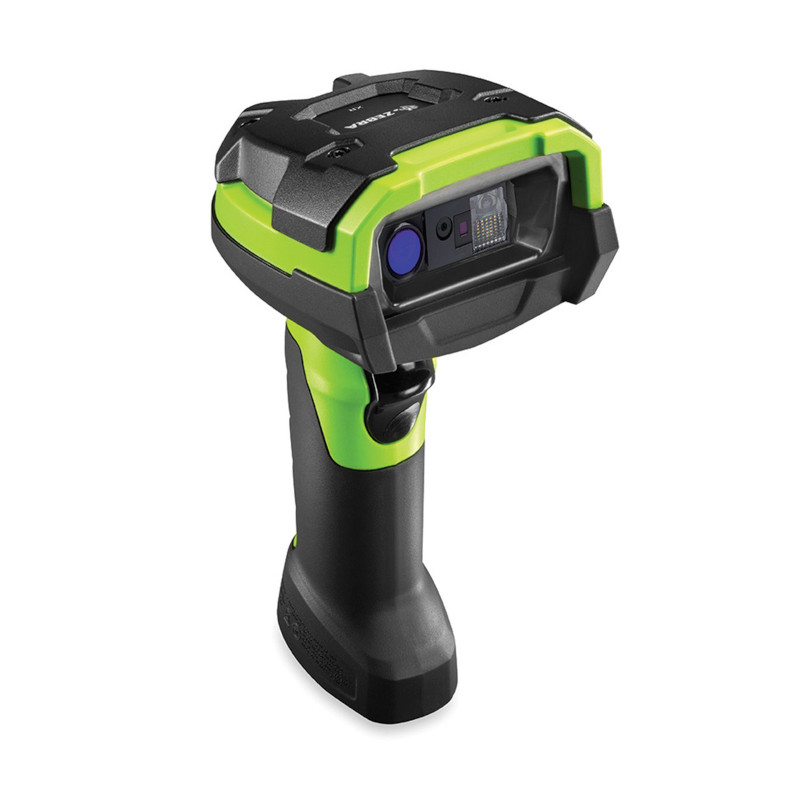 Zebra DS3608 and DS3678 are ultra-rugged 1D and 2D barcode scanners from the DS3600 series for production halls, warehouses and cold stores. They survive drops to concrete, tumbles and being thrown around the workstation, so they work where ordinary scanners do not last. DS3608 is the corded version, DS3678 the cordless Bluetooth version for forklifts and rack work. The series includes several optics versions: from standard range, through very long range, to reading DPM codes marked on parts. 2.4 m drops to concrete across the full operating temperature range: at room temperature the manufacturer specifies 3 m, plus 7500 tumbles from 1 m. The scanner handles everyday drops from the workstation and forklift without downtime. IP65 and IP68 sealing: dust, water and jet washing do not take the scanner out of service. Operation from −30°C for the corded version, from −20°C for the cordless one: for cold stores and freezers. When moving between a freezer and the hall, the manufacturer recommends a heated holder to reduce condensation. Class 1 Bluetooth on the DS3678: at least 100 m range in open air, so the forklift operator scans labels on racks and pallets without getting off. Wi-Fi Friendly mode limits interference with the warehouse network, and Virtual Tether alerts when the scanner goes out of range. PowerPrecision+ 3100 mAh battery: over 100,000 scans per charge, and over 80,000 on the XR version. A gauge on the scanner shows the charge level, and the cradle contacts are rated for 250,000 insertions. PRZM technology and up to 20 codes in one scan: damaged, dirty and poorly printed labels are read on the first try. A read is confirmed by LEDs, a beep, vibration and illumination of the barcode. USB, RS-232 and keyboard wedge: the scanner connects to a PC, mobile computer or POS. One cradle serves up to 7 cordless scanners. Industrial Ethernet through Network Connect: with the manufacturer's adapter the scanner sends data to the machine network over EtherNet/IP, Profinet, Modbus TCP or TCP/IP, without third-party converters. FeatureDS3608DS3678ConnectioncableBluetooth 4.0, corded cradleOperating temperature−30 to 50°C−20 to 50°CPowerthrough the cable3100 mAh batteryFreedom of movementcable lengthat least 100 m in open airWeight305 g407 gKeypad and displaynoneon KD variants Corded or cordless. DS3608 for a fixed production station and the lowest temperatures. DS3678 for forklifts and wherever the operator moves away from the station. SR and HP. SR is enough for typical labels: it reads a 20 mil Code 128 from up to about 71 cm. HP reads the same code from about 114 cm, and also captures photos, documents and text (OCR). XR, very long range. XR reads codes from a few centimeters to tens of meters: a 15 mil Code 128 from about 4 m, and large 100 mil codes from more than 26 m. The green laser aimer stays visible across the whole decode range. XR is the successor to the ER version and according to the manufacturer offers over 40% more range. HD and DP. HD is for very small, dense codes. DP reads DPM codes that are dot-peened, laser-etched, chemically etched or ink-marked on parts, including shiny and curved surfaces, as well as regular labels. KD, keypad and display. DS3678 variants with 19 keys and a color display let the operator key in data such as a quantity without walking to a PC. Kit. Some variants are the scanner only, and some are kits with a cable, cradle and power supply. In kits, check the AC line cord: it may be a US cord or missing altogether, in which case we add a European one. Line integration. At automated stations choose a kit with the Ethernet adapter, in the Profinet or EtherNet/IP version. The manufacturer provides a 36-month warranty on the scanner and cradle and 12 months on the battery.
 Datalogic
Datalogic CODiScan
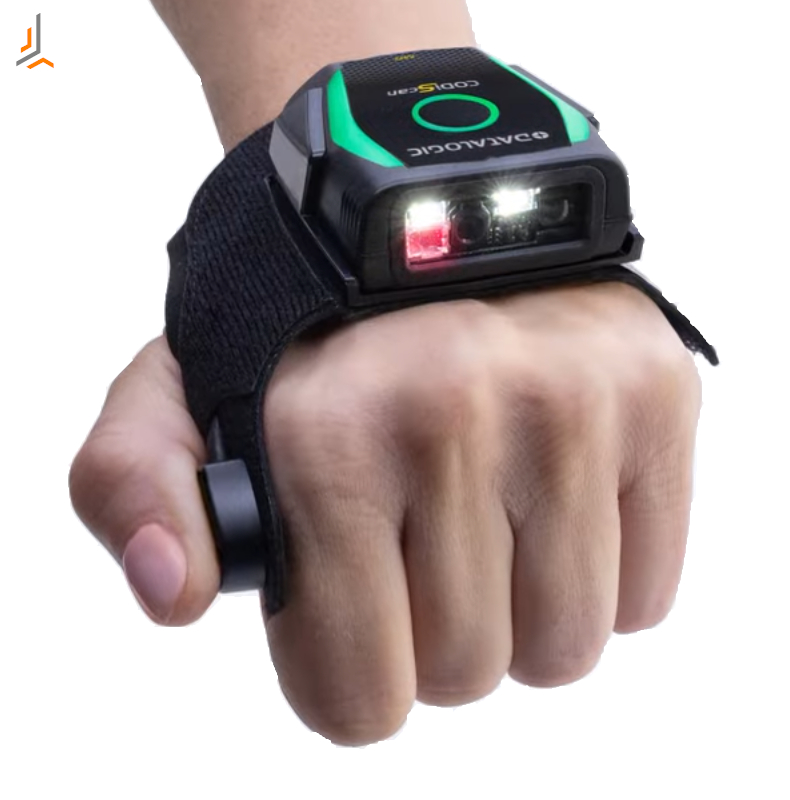
Datalogic CODiScan is a lightweight, portable barcode scanner that enables hands-free scanning of 1D and 2D barcodes. It allows warehouse, production workers to work faster, improving the quality of their work. It is equipped with an intelligent targeting system that recognizes the barcode before it is scanned. Vibration and clear multi-colored LEDs further improve interaction with operators. It is ideal for multi-shift establishments, as after a single charge, the scanner can operate for as long as 16 hours, making as many as 12,000 scans in that time. Other important parameters: Weight 44 g, WiFi, Bluetooth 5.2, IP54, Audio 85 dbA, 1D/2D reading up to 1.5 m, 12-month warranty
Frequently asked questions
How does a barcode scanner work?
The scanner illuminates the barcode and reads it with a laser or a camera (imager), then sends the content to a computer, mobile computer or system, as if it were typed on a keyboard. Laser and linear scanners read 1D codes only, while 2D imagers also read QR and Data Matrix codes.
1D or 2D scanner?
A 2D scanner is the sensible choice today. It reads both 1D and 2D codes (QR, Data Matrix, GS1 DataMatrix), codes on phone screens and damaged or poorly printed codes, so it will not hold you back when suppliers change their labels.
Corded or cordless?
A corded scanner is enough at a checkout, packing station or desk. Choose a cordless scanner with a base when the worker scans goods on a pallet, rack or machine, a few meters from the computer. Keep charging and radio range at the site in mind.
Standard or industrial scanner?
A standard scanner suits shops and offices. An industrial scanner has a reinforced housing resistant to drops, dust and water, works at low temperatures and reads codes from a greater distance, so it suits warehouses and production halls.
Scanner or mobile computer?
A scanner passes the code to the device it is connected to, so it needs a workstation with a computer. If the worker handles the whole process on the move, a mobile computer with a built-in scanner is better. At a workstation with no room for a PC, our Bilberry xT micro-kiosk with a cordless scanner works well: the operator scans within a few meters, and data goes to the system without a PC.
How to buy scanners from HDF?
We supply scanners mainly as part of workstations and deployments: with HDF WMS, HDF MES, in a kit with Bilberry xT or for many workstations at once. Describe your process at [email protected] and we will propose a complete workstation.