Label printers
We match label printers to your print volume and working conditions, from small desktop models to industrial printers for 24/7 work, and deploy them with HDF Labels, HDF WMS, HDF MES and HDF Inwentaryzacja.
Manufacturer:
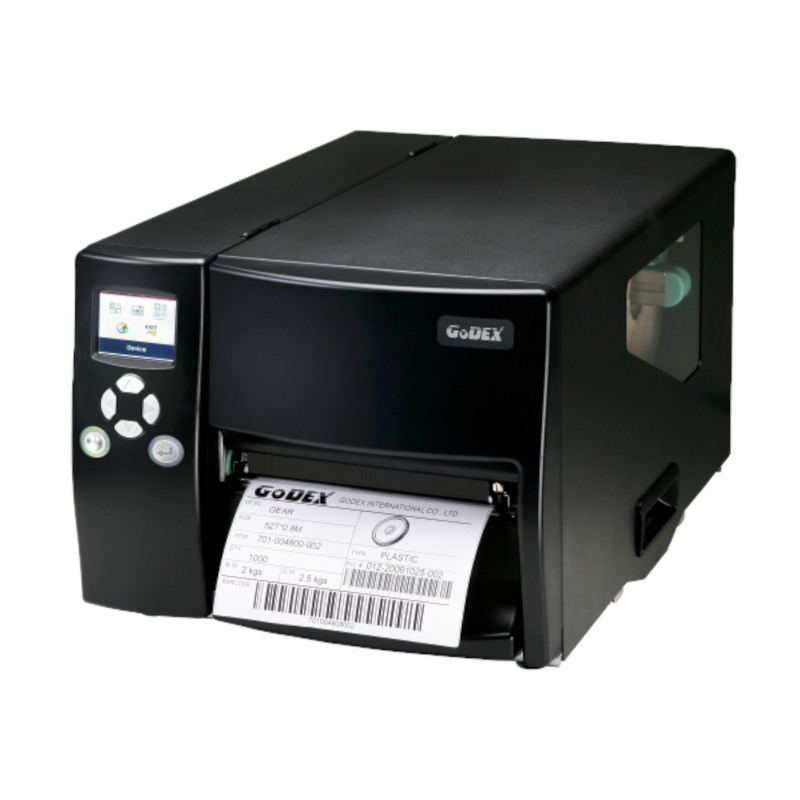 Godex EZ6250i and EZ6350i are industrial label printers with a 168 mm print width, printing thermal transfer and direct thermal labels wider than typical 4-inch printers can handle. They print large logistics and pallet labels, labels for shipping cartons and industrial packaging. The EZ6250i works at 203 dpi and the EZ6350i at 300 dpi. Housing, mechanism, interfaces and options are shared. 168 mm print width, labels 50.8 to 178 mm wide: an A5 format fits on one label, e.g. a pallet label with several barcodes and a product description. Metal housing and robust print mechanism: built for continuous work on large runs in the warehouse and on the shop floor. Ribbon up to 450 m, 60 to 174 mm wide: ribbon width is matched to the label, so narrower labels do not waste ribbon. The printer detects ink-in and ink-out ribbons automatically. Label rolls up to 203 mm in diameter on a 3-inch core: large rolls mean fewer media changes during a run. On a 1.5-inch core the roll can be up to 152 mm. Colour LCD with navigation buttons and a calibration button: the operator adjusts settings and calibrates media at the printer, with no software on a PC. ZPL emulation (GZPL) plus EZPL, GEPL and GDPL with automatic switching: the printer accepts print jobs from systems set up for other popular label printers. It is worth testing your own label formats before ordering more printers. USB, RS-232, Ethernet and a USB host port, real-time clock as standard: connect the printer to the network or to legacy equipment over the serial port. The USB host extends memory and allows printing without a PC, and the clock prints date and time on the label. Modular printhead: the printhead is easy to replace, which shortens downtime during service. Options: cutter, label dispenser with internal liner rewinder, applicator interface, parallel port and external label rewinder. Resolution and speed. The EZ6250i (203 dpi, up to 177 mm/s) covers logistics, pallet and shipping labels. Choose the EZ6350i (300 dpi, up to 127 mm/s) when a large label carries fine text, an ingredients table or dense 2D codes. Maximum print length. It depends on resolution: up to 1,778 mm on the EZ6250i and up to 762 mm on the EZ6350i. Label width. The printer takes labels from 50.8 mm wide. If most of your labels are up to 100 mm wide, a 4-inch printer is enough. The EZ6250i and EZ6350i make sense when you need labels wider than 104 mm. Label output. By default labels are torn off. Choose a cutter to cut labels one by one or in batches. Choose a dispenser with liner rewinder when each label is applied right after printing, and the applicator interface when the printer works with an automatic applicator. Operating conditions. The manufacturer specifies an operating temperature of 5 to 40°C, so the printer is not intended for cold stores or freezers.
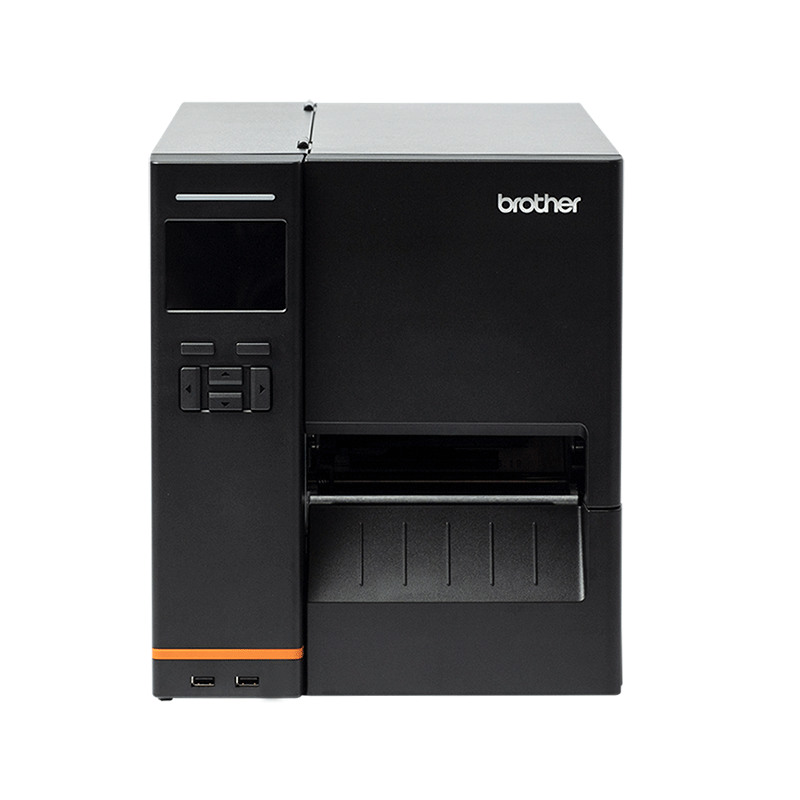 Brother TJ-4420TN, TJ-4520TN, TJ-4422TN and TJ-4522TN are 4-inch industrial label printers for thermal transfer and direct thermal printing on labels 20 to 114 mm wide. They are built for heavy use in warehouses, shipping and production. The models differ in resolution (203 or 300 dpi) and control panel: the TJ-4420TN and TJ-4520TN have a 3.5-inch colour display, while the TJ-4422TN and TJ-4522TN have a 4.3-inch touchscreen and an internal label rewinder. Ribbon up to 600 m on a 1-inch core, 25.4 to 114.3 mm wide: one ribbon roll lasts a long run, so there are fewer media change breaks during a shift. Up to 356 mm/s at 203 dpi and up to 305 mm/s at 300 dpi: the printer keeps up with large runs of shipping and product labels. Metal frame and cover: built for demanding production and warehouse conditions. Operating temperature 0 to 40°C: the printer can also stand in a chilled room above freezing. It is not suitable for freezers. ZPL2, EPL2 and DPL emulation (FBPL-EZD): the printer accepts print jobs from systems set up for other popular label printers. It is worth testing your own label formats before ordering more printers. USB, USB host, RS-232 and Ethernet as standard, Wi-Fi and Bluetooth as an option: connect the printer to the network, a PC or legacy equipment over the serial port. The Wi-Fi and Bluetooth module is user-installable. 256 MB RAM, 512 MB flash and a microSD card slot up to 32 GB: room for label formats, fonts and graphics stored in the printer. Label rolls up to 203 mm in diameter, 38.1 to 76.2 mm core: the printer takes large rolls, so labels are changed less often too. BarTender Ultra Lite and Brother Printer Management Tool: barcode label design software and a tool for managing several printers on the network, their settings and updates. Resolution and speed. The TJ-4420TN and TJ-4422TN (203 dpi, up to 356 mm/s) cover logistics, pallet and shipping labels. Choose the TJ-4520TN and TJ-4522TN (300 dpi, up to 305 mm/s) for product labels with fine text and 2D codes. Maximum print length is 25,400 mm at 203 dpi and 11,430 mm at 300 dpi. Panel and rewinder. The TJ-4420TN and TJ-4520TN have a 3.5-inch colour display with buttons. The TJ-4422TN and TJ-4522TN have a 4.3-inch touchscreen and an internal rewinder that winds printed labels onto a roll inside the printer, e.g. for applying later on the line. Peeler and cutter. They are available only for the TJ-4420TN and TJ-4520TN and are installed by a service partner. The peeler with liner rewinder helps when each label is applied right after printing, the cutter when labels are cut one by one or in batches. Minimum label length depends on the mode: 50 mm for tear-off, 25.4 mm for cutting and 12.7 mm for peeling. Wireless. Wi-Fi and Bluetooth need a module bought separately, shared by all four models.
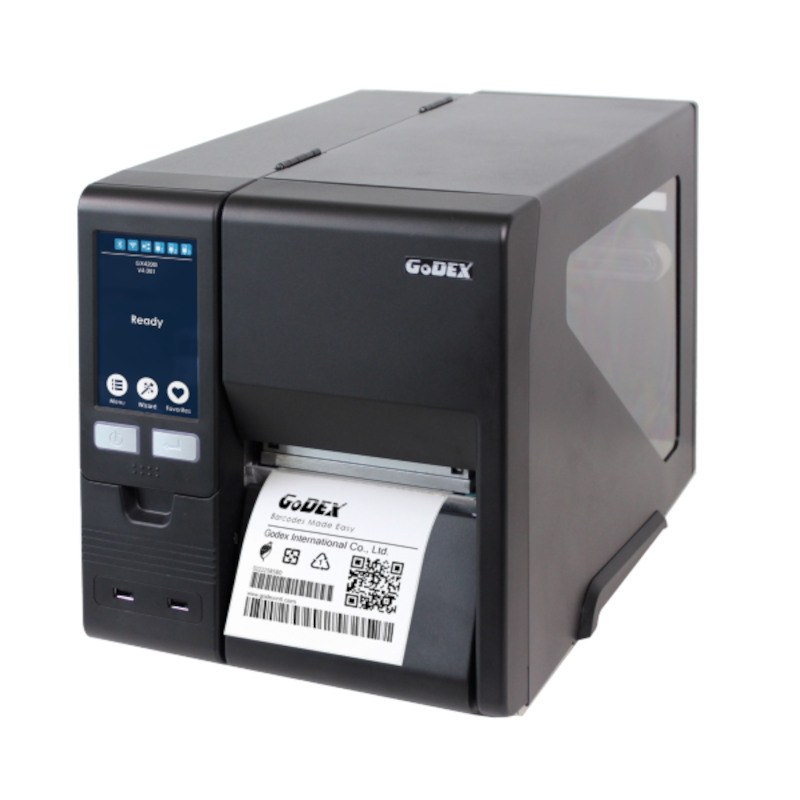 Godex GX4300i PRO and GX4600i PRO are high-speed industrial label printers in a steel housing, printing thermal transfer and direct thermal labels up to 118 mm wide. They are built for production lines and large shipping departments, where print speed sets the pace of the workstation. The GX4300i PRO prints at 300 dpi at up to 305 mm/s, and the GX4600i PRO at 600 dpi at up to 203 mm/s. Up to 305 mm/s at 300 dpi and up to 203 mm/s at 600 dpi: the printer keeps up with a fast line and with large batches of shipping labels, even with fine 600 dpi output. Steel housing and cast aluminium frame: built for continuous work in production halls and warehouses while keeping print precision. 5-inch colour touchscreen with how-to videos: the operator sees on screen how to load labels and ribbon, and saves favourite settings in one place. Fewer calls to IT after a media change. Resolution changed by swapping the printhead (203, 300 or 600 dpi): when labels change, the printer moves to a different resolution without buying another device. Ribbon up to 450 m and label rolls up to 203 mm in diameter: at high speed, media is changed less often. The ribbon is 30 to 110 mm wide on a 1-inch core. Media 0.06 to 0.25 mm thick and 25.4 to 118 mm wide: besides logistics labels, the printer handles marking of small components, cables, tubes and nameplates. ZPL emulation (GZPL) plus EZPL, GEPL and GDPL with automatic switching: the printer accepts print jobs from systems set up for other popular label printers. It is worth testing your own label formats before ordering more printers. USB, RS-232, Ethernet and three USB host ports (two front, one rear): connect the printer to the network or to legacy equipment over the serial port, and plug a scanner or keyboard into the front. Options: cutter (rotary, guillotine, perforation, high-speed, paper card), label dispenser with internal liner rewinder, DSUB-15 applicator interface, external label rewinder and unwinder. The manufacturer offers a UHF RFID module as a project option. Resolution and speed. The GX4300i PRO (300 dpi, up to 305 mm/s) suits product, logistics and shipping labels printed in large runs. Choose the GX4600i PRO (600 dpi, up to 203 mm/s) for small labels with fine text and dense 2D codes: electronic components, cables and tubes. Label output. By default labels are torn off. Choose a cutter when labels must be cut one by one or in batches, a dispenser with liner rewinder when the operator applies each label right after printing, and the applicator interface when the printer works with an automatic applicator on the line. Operating conditions. The manufacturer specifies an operating temperature of 5 to 40°C, so the printer is not intended for cold stores or freezers.
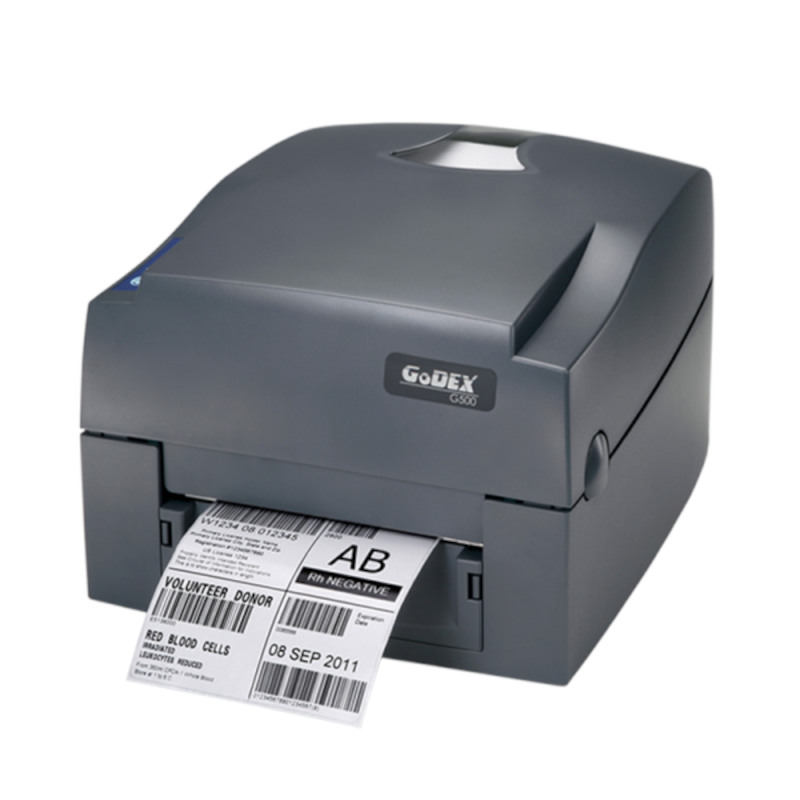 Godex G500 and Godex G530 are desktop label printers for thermal transfer and direct thermal printing on labels up to 118 mm wide. They fit offices, shops and smaller warehouses: fixed asset tagging, product and shipping labels, and shelf labels. Both models share the same housing and mechanism. The G500 prints at 203 dpi and the G530 at 300 dpi. Ribbon up to 300 m on a 1-inch core: one ribbon roll lasts a long time, and ribbons in this format are easy to match to the material, including resin ribbons for film labels. Label rolls up to 127 mm in diameter, 1, 1.5 or 3-inch core: the printer takes typical label rolls. Larger rolls are fed from an external holder. Two media sensors (Twin-Sensor): adjustable reflective and transmissive: the printer detects gap labels, black mark, punched hole and continuous media, including specialty materials. Media 0.06 to 0.25 mm thick and 25.4 to 118 mm wide: paper, film and heavier tag stock. ZPL emulation (GZPL) plus EZPL, GEPL and GDPL with automatic switching: the printer accepts print jobs from systems set up for other popular label printers. It is worth testing your own label formats before ordering more printers. USB-only versions, or USB, RS-232 and Ethernet: a single workstation next to one PC, or a network printer shared by several people. Drivers for Windows, macOS and Linux, plus GoLabel II software: the printer runs in a typical office without extra tools. GoTools and GoUtility: check printer settings and status from a PC instead of hunting through the device menu, which makes it easier to look after several printers in the company. Housing 285 × 232 × 173 mm, weight 2.5 kg: fits on a desk or counter. Resolution. The G500 (203 dpi, up to 127 mm/s) covers shipping, warehouse and product labels in typical sizes. Choose the G530 (300 dpi, up to 102 mm/s) for small labels: asset tags with QR codes, fine text and 2D codes on labels a few centimetres across. Interfaces. The USB-only version is enough when the printer sits next to one PC. Choose the USB, RS-232 and Ethernet version when several people print over the network or the printer must work with legacy equipment over the serial port. Label output. By default labels are torn off. Choose a cutter for tags and pieces of continuous media, and a dispenser when each label is applied right after printing. Wireless. The printer has no Wi-Fi or Bluetooth. Network printing needs an Ethernet socket at the workstation.
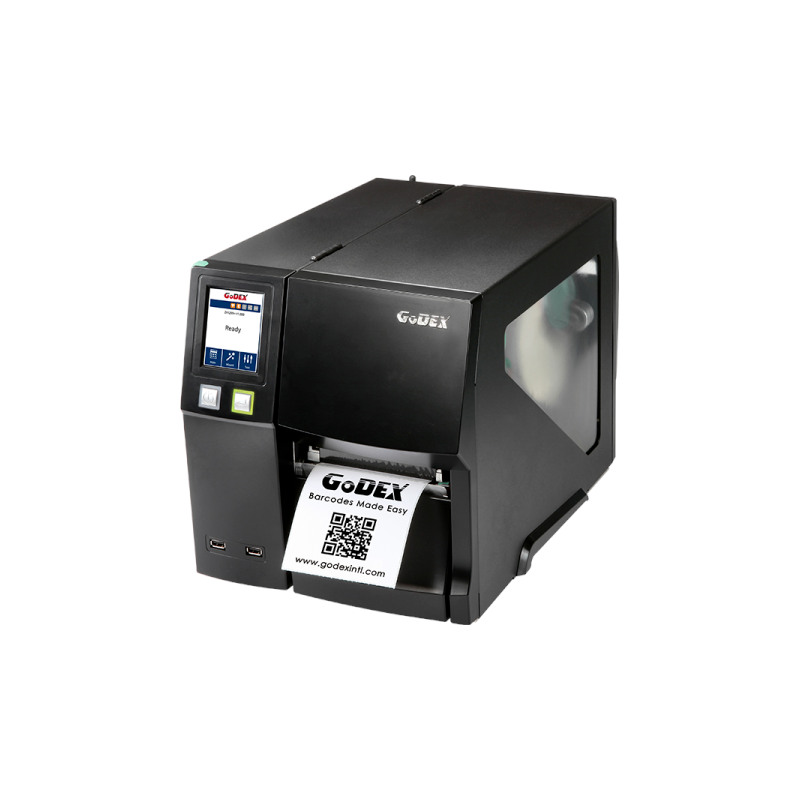 Godex ZX1200i PRO, ZX1300i PRO and ZX1600i PRO are industrial label printers in a metal housing, printing thermal transfer and direct thermal labels up to 118 mm wide. They are built for production lines, warehouses and shipping departments, where labels are printed in large runs throughout the shift. All three models share the same housing, mechanism, interfaces and options. They differ only in printhead resolution: 203, 300 or 600 dpi. Metal frame and die-cast print mechanism: built for continuous operation in production halls and warehouses. The printhead and platen roller are designed for easy removal, so replacing them does not mean long downtime. Ribbon up to 450 m and label rolls up to 203 mm in diameter: in long runs, media is changed less often. The printer detects ink-in and ink-out ribbons automatically. ZPL emulation (GZPL) plus EZPL, GEPL and GDPL with automatic switching: the printer accepts print jobs from systems set up for other popular label printers. It is worth testing your own label formats before ordering more printers. Direct PDF printing: a PDF document goes to the printer without installing a driver on the computer. Gigabit Ethernet with IEEE 802.1X, USB 3.2, RS-232 and three USB host ports (two front, one rear): the printer fits into a secured corporate network or connects to legacy equipment over the serial port. Wi-Fi and Bluetooth work through a USB dongle from the compatibility list in the manufacturer's manual. 3.2-inch colour touchscreen and a dedicated calibration button: the operator adjusts settings and calibrates media at the printer, with no software on a PC. 16 GB flash and 2 GB RAM: room for label formats, fonts and graphics stored in the printer. Options: cutter (rotary, guillotine, perforation, high-speed, paper card), label dispenser with internal liner rewinder, DSUB-15 applicator interface, external label rewinder and unwinder. The manufacturer offers an RFID module as a project option. Resolution and speed. ZX1200i PRO (203 dpi, up to 254 mm/s) covers logistics, pallet and shipping labels. ZX1300i PRO (300 dpi, up to 178 mm/s) suits product labels with finer text and 2D codes. ZX1600i PRO (600 dpi, up to 102 mm/s) prints the smallest details: small labels, fine text and dense 2D codes. Maximum print length. It depends on resolution: up to 10,160 mm on ZX1200i PRO, 8,890 mm on ZX1300i PRO and 2,540 mm on ZX1600i PRO. This matters for long labels and continuous marking. Label output. By default labels are torn off. Choose a cutter when labels must be cut one by one or in batches, a dispenser with liner rewinder when the operator applies each label right after printing, and the applicator interface when the printer works with an automatic applicator on the line. Wireless. The printer has no built-in Wi-Fi. If there is no network socket nearby, you need a USB dongle from the compatibility list.
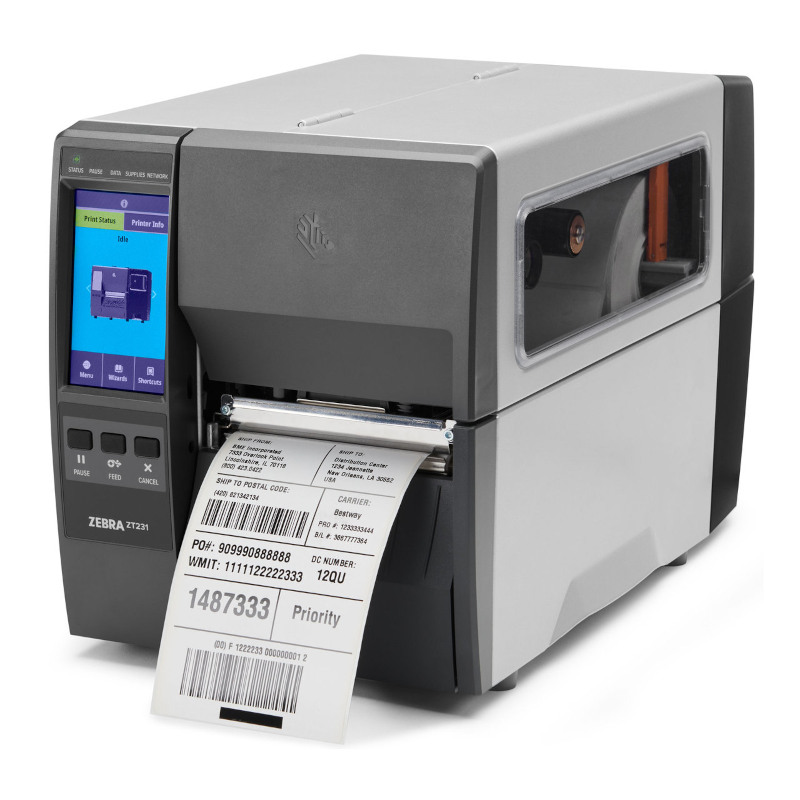 Zebra ZT231 is a semi-industrial label printer with a metal frame and a 104 mm print width, the successor to the ZT230. It works at warehouse, packing and light-industry stations where logistics, shipping and product labels are printed throughout the shift. ZT231R is the same printer with a built-in UHF RFID encoder: it prints the label and encodes the chip in a single pass. 203 dpi at up to 305 mm/s or 300 dpi at up to 203 mm/s: 203 dpi is enough for logistics and shipping labels, while 300 dpi helps with small text, small 2D codes and product labels. Metal frame and housing in a compact size: 432 × 241 × 279 mm and 9.1 kg, so the printer takes little space at the workstation. The bi-fold cover with a window needs less clearance above the printer when opened. 4.3-inch color touch display: printer status and settings, including RFID settings on the ZT231R, are changed from the on-screen menu without a computer. Three-color LEDs show the status at a glance. Large label and ribbon rolls: label rolls up to 203 mm in diameter on a 76 mm core and 450 m ribbons mean fewer media changes during a shift. The printer takes media from 19.4 to 114 mm wide and from 0.076 to 0.25 mm thick. Standard connectivity: USB 2.0, RS-232, 10/100 Ethernet, USB host and Bluetooth Low Energy. Wi-Fi 802.11ac comes factory-fitted in some variants or as a card added later. Wi-Fi 6 is not available. ZPL and ZPL II, plus EPL on 203 dpi models: ZPL is shared across Zebra printers, so label formats from earlier printers of this brand can still be used. EPL makes it easier to work with legacy systems. Upgrades after purchase: the peeler, cutter, Wi-Fi card, second Ethernet card, applicator interface and UHF RFID module are installed on site. The exception is the peeler with liner take-up, which is factory-fitted only. Print DNA: Zebra software for configuring, updating and remotely managing networked printers. Feature availability depends on the model, and some features require a license. Print method. Thermal transfer prints through a ribbon, so print durability is matched to the material by choosing the ribbon, including for film labels. Direct thermal needs no ribbon and is enough for short-life shipping labels. Thermal transfer operates from 5°C, direct thermal from 0°C, both up to 40°C. Resolution. 203 dpi gives higher speed and EPL support. Choose 300 dpi when the label carries a lot of small content or small 2D codes. Media handling. Tear-off is standard. The peeler presents a label ready to apply at the packing station, and the version with liner take-up also rewinds the liner. The cutter cuts tags and continuous media. Wi-Fi. Choose a Wi-Fi variant when there is no network outlet at the workstation. A Wi-Fi card can also be added later. RFID. The ZT231R variants on this page are thermal transfer with tear-off, 203 or 300 dpi. The RE40 encoder supports UHF EPC Gen2 v2.1, ISO/IEC 18000-63 and RAIN RFID tags, and Adaptive Encoding selects the encoding settings automatically. The minimum RFID label pitch is 16 mm. For a different RFID configuration, add the UHF RFID module to a ZT231.
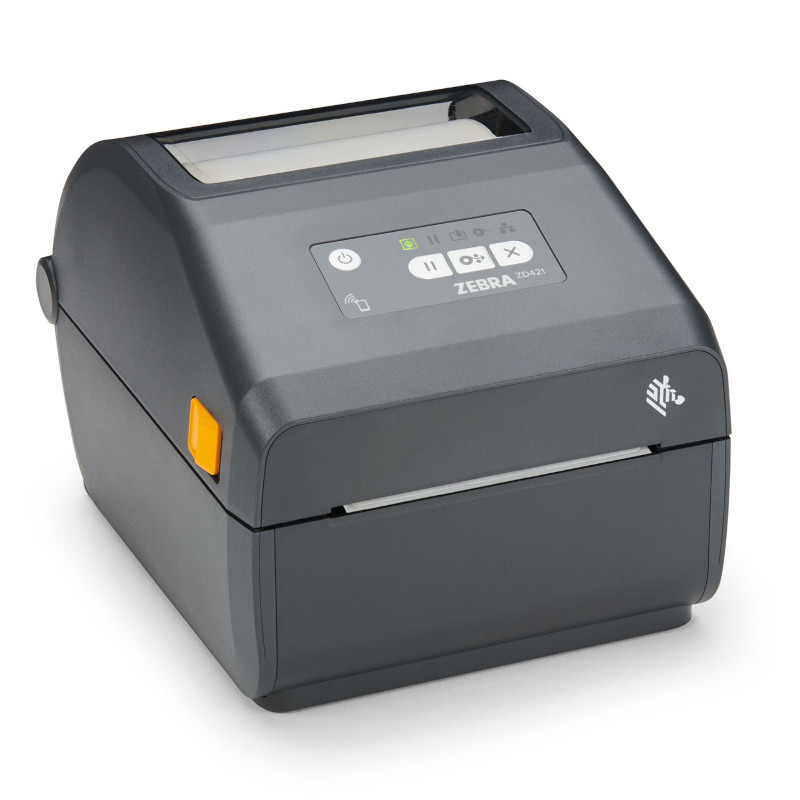 Zebra ZD421d and ZD421t are desktop label printers with a print width of up to 108 mm. They print shipping, product and warehouse labels as well as asset tags, e.g. at packing stations, in goods receiving or in the office. ZD421d prints direct thermal, without ribbon. ZD421t also prints thermal transfer, with ribbon, on paper or synthetic (film) labels, which gives a durable print. 203 dpi at up to 152 mm/s or 300 dpi at up to 102 mm/s: 203 dpi covers shipping and logistics labels, 300 dpi suits small labels with fine text and dense 2D barcodes. Rolls up to 127 mm in diameter, 12.7 and 25.4 mm cores, 38, 51 and 76 mm with adapters: the printer takes rolls from various suppliers as well as fan-fold media fed through the rear slot. Media width from 15 to 108 mm (ZD421d) or up to 112 mm (ZD421t). Movable media sensor: detects gaps, black marks and notches, so non-standard labels and tags are positioned correctly. ZPL II, EPL2 and PDF Direct: templates made for older Zebra printers work without changes, and PDF files can be sent straight to the printer. Field upgrades: the Ethernet module, RS-232 port, 802.11ac Wi-Fi with Bluetooth 4.1 module, cutter and dispenser (peeler) are installed in a printer already in use, with no trip to a service center. Battery power: the optional battery base with a 2750 mAh battery lets you print without a power outlet, e.g. on a cart moved between racks. Link-OS and Print DNA: remote configuration, firmware updates and printer monitoring. Initial setup is done from a phone (app over Bluetooth Low Energy or by tapping the Print Touch tag). 3-year manufacturer warranty, printhead 1 year or 1 million inches: the printhead and platen roller are user-replaceable parts, so the printer does not have to be sent away. Coverage can be extended with Zebra OneCare. Print method. ZD421d (direct thermal) is smaller and lighter (1.35 kg) and needs no ribbon. Direct thermal print fades over time until the label becomes unreadable, so choose ZD421d for shipping labels and other short-lived labels. ZD421t (thermal transfer, 2.05 kg) prints with 300 m or 74 m ribbons on paper and synthetic labels. Choose it when the label has to stay readable for a long time, e.g. on fixed assets, finished goods or warehouse locations. Resolution. 203 dpi means higher speed (up to 152 mm/s) and a 104 mm print width, the standard for logistics labels. Choose 300 dpi (up to 102 mm/s, 108 mm print width) for small labels, fine product text and dense Data Matrix or QR codes. Connectivity. Every variant has USB, USB Host and Bluetooth Low Energy for setup from a phone. The Ethernet version fits workstations on the company network. The Wi-Fi 6 and Bluetooth 5.3 version prints wirelessly, including from mobile computers. Ethernet and 802.11ac Wi-Fi with Bluetooth 4.1 can be added later as modules, while Wi-Fi 6 is best chosen factory-installed.
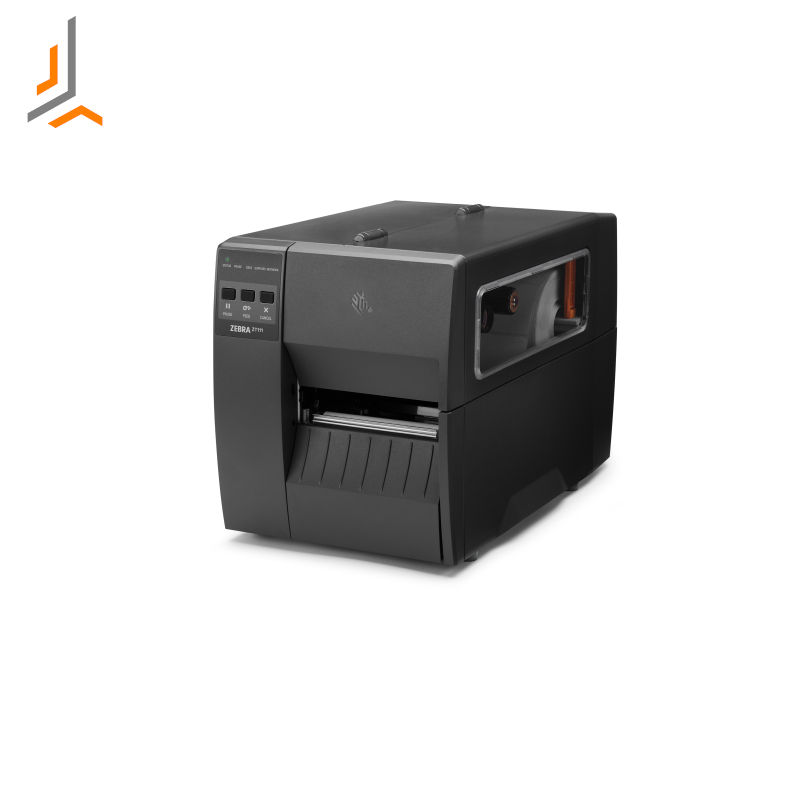 Zebra ZT111 is a semi-industrial thermal or thermal transfer label printer with a 104 mm print width. It is built for companies that have outgrown a desktop printer: those printing labels in series and across several shifts in warehousing, logistics and production. It has a metal frame but a plastic housing, which is the trade-off in this class. In return, it takes large label rolls and long ribbons. Printing up to 254 mm/s at 203 dpi, up to 152 mm/s at 300 dpi: a batch of shipping or product labels prints without waiting at the printer. Label rolls up to 203 mm in diameter on a 76 mm core, ribbons up to 450 m: labels and ribbon are changed far less often than in desktop printers, and long runs print without interruption. Metal frame, plastic housing and a bi-fold cover with a large window: the structure is stable, although the housing is plastic, which is worth knowing for harsh conditions. The bi-fold cover needs less clearance above the printer, and the window shows how many labels are left on the roll. Side loading with color-coded touch points and adjustable media sensors: the roll and ribbon are loaded without training. The printer handles continuous, die-cut, notched and black-mark labels from 19.4 to 114 mm wide. Simple operation and maintenance: 3 buttons and 5 status LEDs, platen roller and printhead replaced without tools. Built-in analytics and a printhead element sensor let you plan maintenance in advance. USB, RS-232, Ethernet, USB host and Bluetooth Low Energy as standard: the printer connects to the network without extra cards. The NFC Print Touch tag pairs it with a phone or tablet with a single tap. ZPL and EPL languages and emulation of other printer brands: the ZT111 can replace an older printer without changing label formats or writing new code on the system side. Secure Boot, Protected Mode and a decommissioning process: settings cannot be changed by accident, and before the printer is moved its configuration and files are wiped in a single process. Print technology. Direct thermal needs no ribbon and suits short-life labels such as shipping labels. Thermal transfer with a ribbon gives a durable print for product and warehouse labels that must last for months. The direct thermal version operates from 0°C, thermal transfer from 5°C. Resolution. 203 dpi is enough for logistics labels and prints fastest (up to 254 mm/s). Choose 300 dpi for small labels, fine text and dense 2D codes, at the cost of speed (up to 152 mm/s). EPL is available only on 203 dpi models. Connectivity. The standard ports are enough on a wired network. An 802.11ac Wi-Fi card or a second Ethernet card are options that can also be added later, without replacing the printer. Media handling. Tear-off is standard. The peeler presents the label separated from the liner, ready for manual application, and the guillotine cutter cuts continuous media and labels to length. Standalone printing. The ZKDU keyboard display unit lets you print stored label formats without a computer.
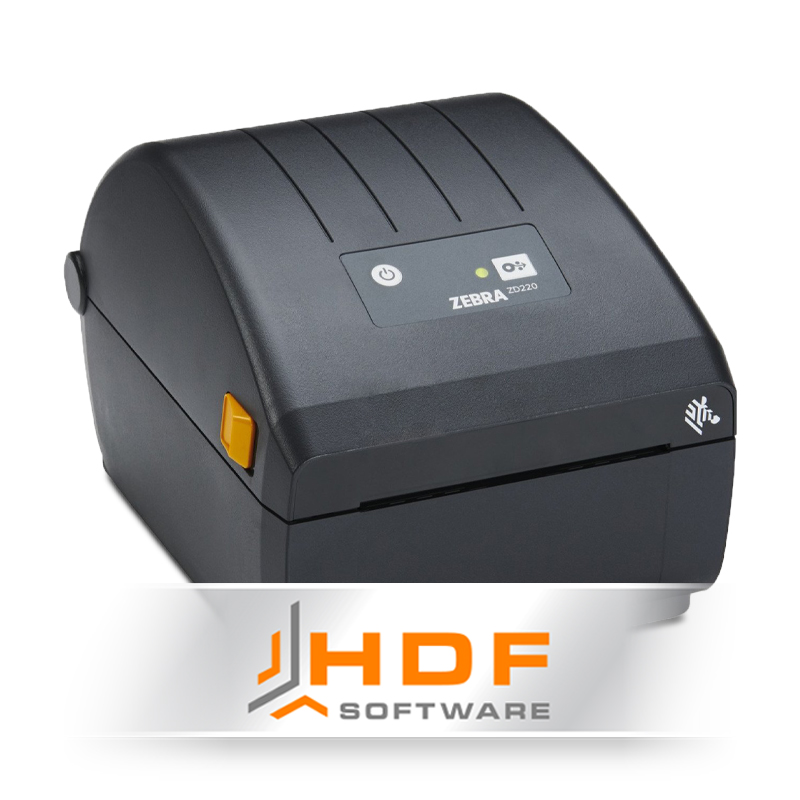 Zebra ZD220 and ZD230 are small desktop label printers for direct thermal or thermal transfer printing with a 104 mm print width. They work well where label volumes are low and budget matters: fixed asset tagging, offices, small warehouses, shipping and production workstations with few prints. ZD220 is the basic USB model, while ZD230 prints faster, takes a longer ribbon and can be factory-fitted with Ethernet or Wi-Fi. For large runs and multi-shift work, a semi-industrial printer such as the Zebra ZT111 is a better fit. Printing up to 102 mm/s (ZD220) or 152 mm/s (ZD230), 203 dpi: labels are ready on demand, and the resolution is enough for 1D and 2D barcodes, text and simple logos. OpenACCESS clamshell design: the printer opens like a lid and the roll is loaded without training, which matters more than speed for occasional printing. Rolls up to 127 mm in diameter on 12.7 or 25.4 mm cores, media width from 25.4 to 112 mm: die-cut and continuous labels, black-mark media, tags, wristbands and fan-fold media. 74 m ribbon, and on the ZD230 also 300 m: the longer ZD230 ribbon means roughly four times fewer changes. ZPL II, EPL 2 and XML: the printer works with software prepared for Zebra printers, so it can replace an older model without changing label formats. One button and one status LED: operation comes down to loading the roll and printing, with no menus or settings on the device. Compact size and a weight of 1.1 kg (direct thermal) or 1.7 kg (thermal transfer): the printer fits on an ordinary desk or a shelf at the workstation. 2-year manufacturer warranty and ENERGY STAR: the warranty runs from the shipping date, and low power consumption matters when the printer stays on all day. ZD220 or ZD230. The ZD220 is enough for occasional printing over USB. Choose the ZD230 when the printer must work on the network (factory Ethernet or 802.11ac Wi-Fi with Bluetooth 4.1), print faster or use the 300 m ribbon. The ZD230 also has more memory for formats and fonts (256 MB Flash vs 128 MB). Print technology. The direct thermal version is smaller, lighter and needs no ribbon, but the print fades over time, so it suits short-life labels such as shipping labels. The thermal transfer version gives a durable print, needed for example on fixed asset labels. Media handling. Both printers can have a factory peeler that presents the label ready to apply. The ZD230 can also have a factory cutter. Connectivity. Ethernet and Wi-Fi on the ZD230 are factory-installed, so they must be chosen at purchase. When to choose another printer. The ZD220/ZD230 operates from 4.4 to 41°C, so it is not suitable for cold stores or unheated halls. For large runs and multi-shift work, the semi-industrial ZT111 is a better choice: it takes rolls up to 203 mm and a 450 m ribbon.
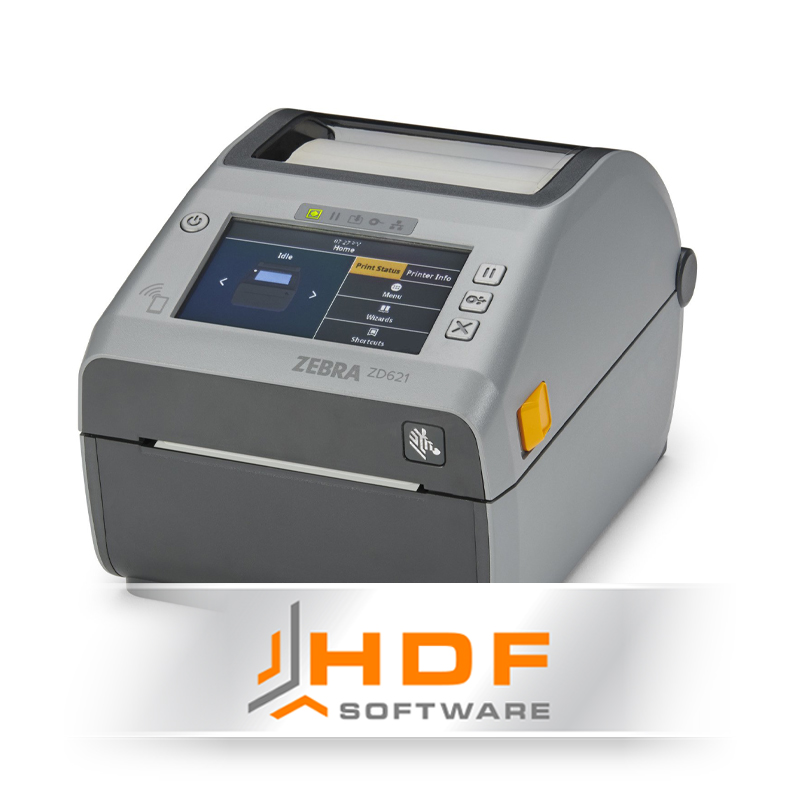 Zebra ZD621 and ZD621R are premium desktop label printers for direct thermal or thermal transfer printing, with a print width of up to 104 mm (203 dpi) or 108 mm (300 dpi). They fit the same places as the lower-cost ZD220/ZD230, but do better when labels are small and dense, the printer must be networked from day one, or it has to print without a PC. ZD621R also prints and encodes UHF RFID labels. The series is the successor to the ZD620 printers. Printing up to 203 mm/s at 203 dpi or up to 152 mm/s at 300 dpi: 300 dpi gives sharp fine text and readable dense 2D codes on small product labels. Ethernet, RS-232, USB 2.0 and USB host as standard: the printer works on the network out of the box. Bluetooth Low Energy is used for setup from a phone. Optional Wi-Fi 6 with Bluetooth 5.3: the module is factory installed or added later, without replacing the printer. Older variants come with Wi-Fi 5 (802.11ac) and Bluetooth 4.2. 4.3-inch color touch display with setup wizards: optional on the ZD621, on every ZD621R variant. The base version has 3 buttons and 5 status icons. Printing without a PC: on models with the display the operator selects a stored format on the printer and enters data with a scanner or keyboard connected to the USB host port. Optional 2750 mAh battery: according to the manufacturer it lasts a shift of printing at full speed and works with the cutter and peeler. The printer can sit on a cart and print labels where they are needed. ZPL and EPL plus emulations of other brands: the printer can replace an older Zebra and, with the Printer Emulations app, printers from other manufacturers too, without changing label formats. It also prints PDF files directly. Rolls up to 127 mm, 74 m or 300 m ribbon: plus a peeler with label-present sensor and a cutter, factory installed or added later. PrintSecure blocks unauthorized access to the networked printer. FeatureDirect thermalThermal transferRibbonnot needed74 m or 300 mPrint durabilityfades over timedurable, depending on the ribbonLabel width15 to 108 mm15 to 118 mmDimensions221 × 177 × 151 mm267 × 202 × 192 mmWeight1.6 kg2.5 kgLinerless labelson linerless variantsnoneRFID (ZD621R)noneyes ZD621 or ZD621R. The ZD621R has a built-in Zebra RE40 RFID reader/encoder (UHF EPC Gen 2 V2.1, RAIN RFID) and the touch display. Choose it when labels must carry an RFID tag. Otherwise the ZD621 is enough. Resolution. 203 dpi for address and logistics labels, and the fastest printing. 300 dpi for small product labels, fine text and 2D codes. Label handling. The base version has a tear-off edge. The peeler presents the label separated from the liner, ready to apply, and the cutter cuts labels and continuous media to size. Both options can also be added later. Connectivity. If the printer sits next to a network socket, Ethernet is enough. Choose a Wi-Fi variant for mobile stations and places without cabling. Display. If the printer is to work without a PC or is used by different people, choose the version with the color touch display. When to choose another model. For occasional USB printing the lower-cost ZD220/ZD230 is enough. For large runs and multi-shift work the semi-industrial ZT111 with 203 mm rolls and 450 m ribbons is a better fit. The ZD621 operates at 4.4 to 41°C. The box includes a power supply, power cords and a USB cable. The manufacturer provides a warranty of at least 2 years.
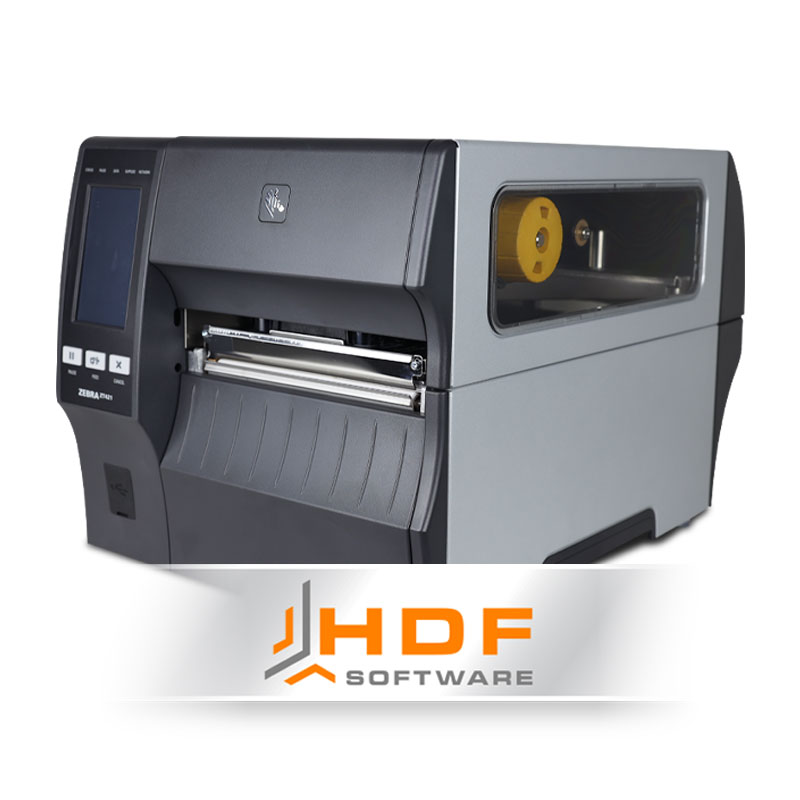 Zebra ZT421 is the wide, 6-inch model of the ZT400 series: a semi-industrial thermal and thermal transfer label printer with a metal frame and metal cover and a print width of up to 168 mm. It is the choice when a label does not fit into the standard 104 mm: large logistics labels, labels for shipping cases, pallets and bulky products. It runs continuously at production lines and in warehouses, with the same operation as the narrower ZT411. Print width up to 168 mm on media up to 178 mm: a full set of logistics data, several barcodes and readable text fit on one label without shrinking the font. Speed up to 305 mm/s: even large labels are printed on demand, at the pace of the line or the shipping area. 203 or 300 dpi resolution: 203 dpi is enough for large logistics labels, 300 dpi gives sharper text and dense 2D codes. Metal frame and bi-fold metal cover: the printer weighs about 18 kg and is built for multi-shift shop-floor work. The gears are reinforced with carbon fiber, and the cover folds to the sides, so little clearance is needed above the printer. 4.3-inch color touch display with an icon-based menu: language, settings and connectivity are changed without a manual, and color status alerts are visible from across the workstation. Backlit, color-coded media path and side loading: the wide label roll (up to 203 mm in diameter on a 76 mm core) and ribbon up to 450 m are loaded reliably even in dim light. Two USB host ports alongside USB, RS-232, Ethernet and Bluetooth: a scanner and a keyboard can be connected at the same time, and the configuration is copied to other printers with a USB drive. Link-OS and Zebra DNA: remote fleet management, integration with SOTI MobiControl and AirWatch, and the Network Connect option for direct connection to an industrial Ethernet network. ZT421 or ZT411. Choose the ZT421 for labels wider than 104 mm. When 4-inch labels are enough, the ZT411 is faster (up to 356 mm/s) and offers options not available on the ZT421: 600 dpi, on-metal RFID, linerless printing and the automated labeling kit. Resolution. 203 dpi for logistics and pallet labels, 300 dpi for product labels with fine text. EPL works only on 203 dpi models. Media handling. Tear-off is standard. Options: guillotine cutter with catch tray, peeler (media up to 171 mm), liner take-up and a factory-installed full-roll rewinder for printed labels. Connectivity. The two open slots take a Wi-Fi 6 (802.11ax) card with Bluetooth 5.3 or a Wi-Fi 5 (802.11ac) card with Bluetooth 4.2, a second Ethernet port, a parallel port or an applicator interface. RFID. UHF RFID (EPC Gen2 v2.1, ISO/IEC 18000-63) is available factory-fitted in the ZT421 RFID model or as a module installed on site in a standard ZT421. The printer selects the optimal encoding settings automatically.
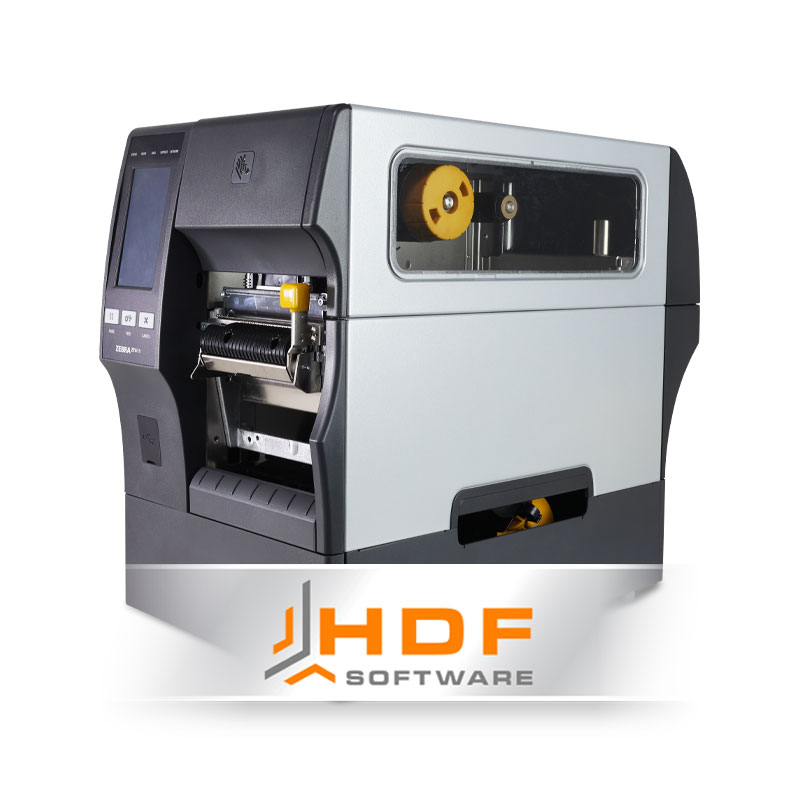 Zebra ZT411 is a semi-industrial thermal and thermal transfer label printer with a metal frame and metal cover and a 104 mm print width. It is built for continuous operation at production lines, in warehouses and logistics centers, where labels are printed in series around the clock. What sets it apart from simpler semi-industrial printers such as the ZT111 is its metal housing, speeds up to 356 mm/s, resolution up to 600 dpi, a color touch display and upgrade options for RFID, linerless printing and print-and-apply. Metal frame and bi-fold metal media cover with a large window: built for multi-shift work on the shop floor and in the warehouse. The gears are reinforced with carbon fiber, and the high-retention USB cable is hard to pull out by accident. The window shows how many labels are left on the roll. Printing up to 356 mm/s with a short time to first label: the label is ready the moment the operator needs it, and large batches do not block the workstation. 203, 300 or 600 dpi resolution: from logistics labels to very small labels with fine text and dense 2D codes. 4.3-inch color touch display: settings, language and connectivity are changed from an icon-based menu without a manual. Color-coded status and error alerts are visible from a distance, so it is clear right away what the printer needs. Side loading with a backlit, color-coded media path: the label roll (up to 203 mm in diameter on a 76 mm core) and ribbon (up to 450 m) are loaded quickly, even in poorly lit areas. USB, RS-232, Ethernet, Bluetooth and two USB host ports as standard: a scanner and keyboard can be connected at the same time, and a USB drive can copy the configuration to other printers. Two open slots take additional connectivity cards. Protective printhead coating and printhead element detection: the coating reduces printhead wear in direct thermal mode, and element detection helps maintain print quality. Link-OS and Zebra DNA tools: networked printers are managed remotely, one by one or as a fleet (Printer Profile Manager Enterprise as an option), also from SOTI MobiControl or AirWatch. The Network Connect option connects the printer directly to an industrial Ethernet network without extra hardware. Resolution. 203 dpi is enough for logistics and pallet labels. 300 dpi gives sharper small product labels. Choose 600 dpi for miniature labels. EPL is available only on 203 dpi models. Width. The ZT411 prints up to 104 mm. For wider labels there is the ZT421 with up to 168 mm. Media handling. Tear-off is standard. Options include a guillotine cutter with catch tray, a peeler, a liner take-up and a factory-installed full-roll rewinder for printed labels. Connectivity. Two slots take a Wi-Fi 6 (802.11ax) card with Bluetooth 5.3 or a Wi-Fi 5 (802.11ac) card with Bluetooth 4.2, a second Ethernet port, a parallel port or an applicator interface. RFID. The UHF RFID module (EPC Gen2 v2.1, ISO/IEC 18000-63) is installed on site, also later. For the ZT411 there is also a version for thicker on-metal RFID labels for metal containers and assets (not on 600 dpi models). Linerless printing. According to the manufacturer, ZeroLiner fits up to 50% more labels per roll and leaves no liner waste. It is available as a factory model (direct thermal only) or as an upgrade kit for existing ZT411 printers. Automation. A field-installable kit (extended peel mechanism, take-up spindle and applicator interface card) prepares the ZT411 for automated labeling systems.
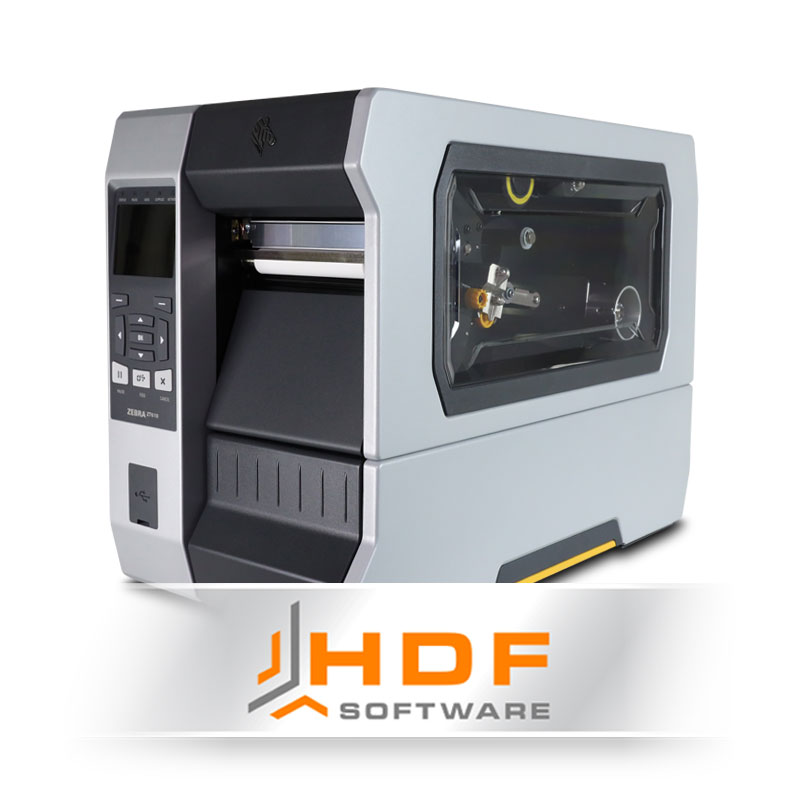 Zebra ZT610 is an industrial label printer for the heaviest workloads and the successor to the 110Xi4: all-metal construction, printing up to 356 mm/s, rolls up to 203 mm and a 450 m ribbon. It is built for large distribution centers and warehouses where labels are printed in series around the clock, many people operate it across shifts, and there is dust and dirt around. Where print volumes are lower, the lower-cost semi-industrial ZT411 is enough. Metal construction with no vents or cooling fans: a built-in thermal management system keeps dust and debris out. The metal frame and bi-fold metal cover are designed for years of 24/7 operation. Printing up to 356 mm/s at 203 dpi, 300 dpi or 600 dpi: shipping and pallet labels never wait for the printer, even at order peaks, and higher resolutions handle small labels with fine text. 4.3-inch color touch display that turns red on error: the operator sees the problem from across the zone, and the icon-based menu is simple for every shift. The marked media path changes color when there is a media problem, and QR codes link to videos that show how to fix the error. Label rolls up to 203 mm in diameter on a 76 mm core and a 450 m ribbon: media is changed rarely, and side loading with a lit path shortens changes and training for new staff. Fast maintenance: the printhead is replaced without disconnecting cables, printhead pressure is set on a scale with color-coded indicators, and the manufacturer states longer printhead life, meaning lower replacement costs. USB 2.0, RS-232, Gigabit Ethernet, Bluetooth and two USB host ports as standard: two open slots take Wi-Fi 6 (802.11ax) with Bluetooth 5.3 or Wi-Fi 5 (802.11ac) with Bluetooth 4.2, a parallel port, an extra Ethernet port or an applicator interface. 1 GB RAM and 2 GB Flash: four times the RAM of the ZT411 (256 MB). Room for many formats, fonts and graphics, and fast processing of complex labels under a constant stream of jobs from the system. Zebra DNA and Link-OS: Printer Profile Manager Enterprise for monitoring the whole fleet from a browser, integration with Workspace ONE and SOTI Connect, and Cloud Connect for encrypted connections to on-premise or cloud servers. Resolution. 203 dpi gives the highest speed for shipping and pallet labels. Choose 300 dpi for smaller product labels. 600 dpi is available only on the ZT610, including the ZT610 Microlabel version that prints labels as small as 3 mm on media from 12 mm, with more precise print registration, at up to 152 mm/s. Width. The ZT610 prints up to 104 mm on media from 20 to 114 mm. For wider labels there is the ZT620 with up to 168 mm. Media handling. Media options are user-installable thanks to built-in connectors: rewinder, peeler with liner take-up, guillotine cutter and an applicator interface for automated labeling. RFID. For UHF RFID encoding there is the factory ZT610 RFID model, and the RFID module can also be easily added to a printer already in service. Operating conditions. The ZT610 operates from 5 to 40°C in thermal transfer mode and from 0 to 40°C in direct thermal mode, so it needs a heated hall. It weighs 22.7 kg and needs a stable table or workstation.
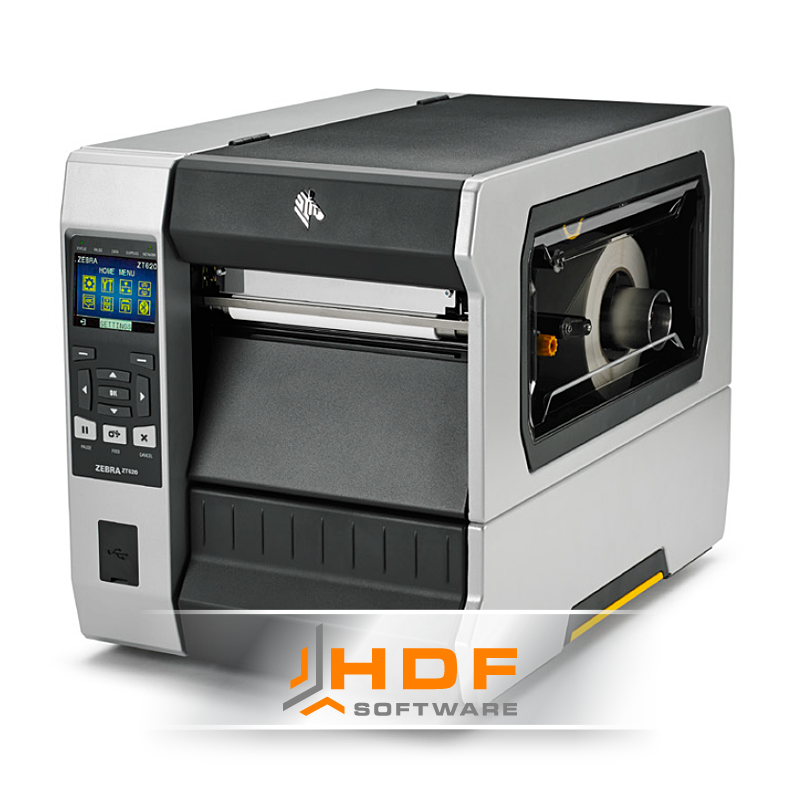 Zebra ZT620 is the wide, 6-inch model of the industrial ZT6 series and the successor to the 170Xi4: it prints labels up to 168 mm wide on media up to 180 mm, continuously around the clock. It is the choice for large pallet and shipping labels, labels for shipping cases and documents that travel with a shipment, for example in A5 format (148 x 210 mm). It shares the metal, fanless construction of the narrower ZT610, so it handles dusty warehouses and many operators across shifts well. Print width up to 168 mm and print length up to 2032 mm: a full set of logistics data, several barcodes and text readable from a distance fit on one label without shrinking the font. Printing up to 305 mm/s at 203 or 300 dpi: even large labels print at the pace of the shipping area, with no job queue. Metal housing with no vents or fans: heat is handled by a built-in thermal management system, so dust does not reach the mechanism. The construction is built for years of 24/7 operation. 4.3-inch color touch display that turns red on error: printer status is visible from a distance, and the menu icons are clear to any operator. The media path changes color when there is a media problem, and QR codes open how-to videos. Rolls up to 203 mm on a 76 mm core and 450 m ribbons up to 170 mm wide: wide media is loaded from the side along a lit path, and changes are rare. Printhead replaced without disconnecting cables: with a wide printhead, easy replacement and pressure adjustment on a scale shorten downtime, and the manufacturer states longer printhead life. USB 2.0, RS-232, Gigabit Ethernet, Bluetooth and two USB host ports: the two open slots take Wi-Fi 6 (802.11ax) with Bluetooth 5.3 or Wi-Fi 5 (802.11ac) with Bluetooth 4.2, a parallel port, a second Ethernet port or an applicator interface. 1 GB RAM, 2 GB Flash and Zebra DNA: large, complex labels are processed quickly, and the printer fleet is managed remotely via Printer Profile Manager Enterprise, Workspace ONE or SOTI Connect. ZT620 or ZT610. Choose the ZT620 for labels wider than 104 mm. When 4-inch labels are enough, the ZT610 is faster (356 mm/s), lighter (22.7 kg vs 26 kg) and is the only one with 600 dpi and a micro-label version. Resolution. 203 dpi for pallet and shipping labels, 300 dpi for labels with fine text or dense 2D codes. Media handling. Rewinder, peeler with liner take-up, guillotine cutter and applicator interface are user-installable thanks to built-in connectors. RFID. For UHF RFID encoding there is the factory ZT620 RFID model, and the RFID module can also be added to a printer already in service. Operating conditions. 5 to 40°C for thermal transfer, 0 to 40°C for direct thermal. The printer weighs 26 kg, so it needs a stable table.
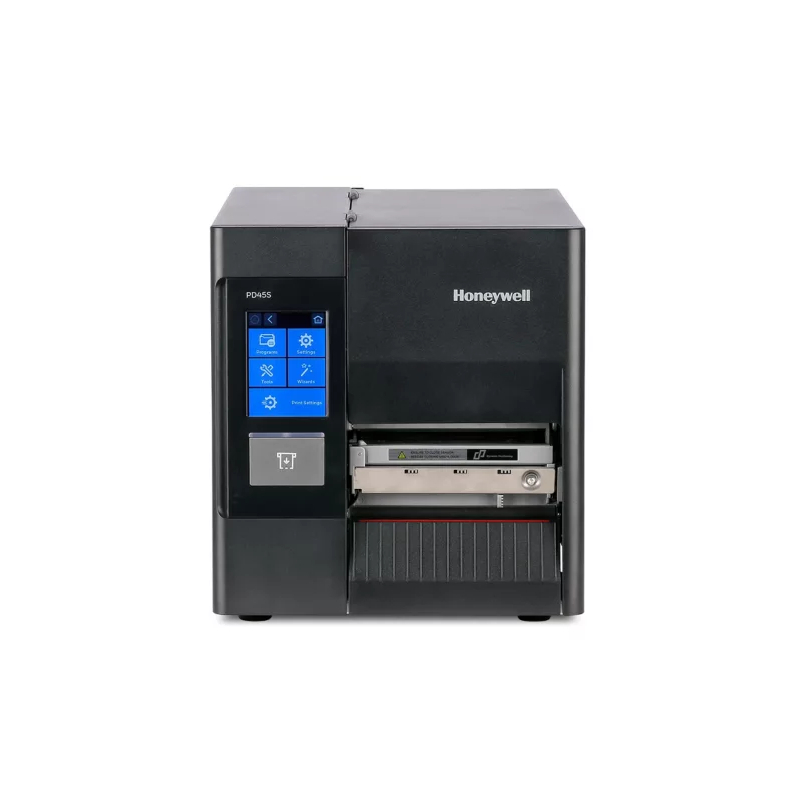 Honeywell PD45S/PD45 industrial printers are devices that are able to operate even in a dust-filled factory floor, thanks to their reinforced metal housing. It is rugged yet compact. It uses thermal and thermal transfer printing methods, prints labels up to 250 mm/sec, and has a choice of label printing resolution, either 203 dpi or 300 dpi. It is capable of operating at temperatures between 5°C and 40°C, and you can connect to it wired (via 10/100 Mbps Ethernet) or wirelessly (using 802.11 a/b/g/n/ac Wi-Fi). You can use the RS-232 interface to connect to the printer. It supports all linear (1D), and two-dimensional (2D) codes, in addition to being compatible with the ZPL-II programming language. The Honeywell PD45S or PD45 industrial printer is very easy to use, which gives you the confidence that it will not cause difficulties for your employees, and even the opposite - it will increase their productivity and make the printing of your logistics labels even faster. This printing device will perform well in harsh conditions, as evidenced by its industrial head, which will convince you that label printing can be of great quality (print accuracy of up to +/-5mm), even at a considerable printing speed, all thanks to the dynamic printing function. Where will it find use? The Honeywell PD45S/PD45 will prove useful in the industrial sector, in industries such as logistics, industry, warehouse, automotive, retail, or healthcare - that is, anywhere you need impeccable, fast printing of a large number of labels, for which the Honeywell PD45S/PD45 is just made.
Frequently asked questions
What is a label printer?
It is a printer that prints self-adhesive labels with barcodes, text and graphics on a roll, usually by direct thermal or thermal transfer printing. Labels are printed one at a time on demand or in series, straight from a warehouse or production system or a labeling program.
Direct thermal or thermal transfer?
Direct thermal needs no ribbon, but the print fades over time, so it suits short-life labels such as shipping labels. Thermal transfer prints through a ribbon and gives a durable print resistant to abrasion, light and chemicals, needed on product, warehouse and fixed asset labels.
Desktop, semi-industrial or industrial printer?
Print volume and working conditions decide. A desktop printer, such as the Zebra ZD220/ZD230, is enough for low volumes, and the ZD621 adds 300 dpi, networking and RFID. A semi-industrial printer, such as the Zebra ZT111 or ZT411/ZT421, takes rolls up to 203 mm and 450 m ribbons, so it prints batches across several shifts. An industrial printer, such as the Zebra ZT610/ZT620, is built for round-the-clock work in dirty environments with many operators.
What does the cost of a label printer depend on?
On the printer class, resolution (203, 300 or 600 dpi), print width, connectivity and options such as a cutter, peeler or RFID. Add consumables to the purchase cost: labels and ribbons, and at high volumes printhead replacement too. We help choose a printer so you do not overpay for capabilities you will not use.
What are RFID printers?
An RFID printer prints the label and at the same time writes data to the UHF RFID tag embedded in it, then verifies the encoding. Our range includes the desktop Zebra ZD621R and the semi-industrial and industrial Zebra ZT411, ZT421, ZT610 and ZT620 in RFID versions or with a field-installable module.
Do you supply labels, ribbons and software?
Yes. We match labels and ribbons to the printer and application, including non-standard formats, and deliver them regularly. For label design and printing we offer HDF Labels, and we also deploy printers with HDF WMS, HDF MES and HDF Inwentaryzacja.