- Home page
- How to Design a GS1 Logistics ...
How to Design a GS1 Logistics Label: Guide to Standards, SSCC Codes, and Automation
One such solution is the GS1 logistics label, which enables clear and structured labeling of palletized goods, tracking warehouse movement, and streamlining logistics processes.
Use this guide to learn what the SSCC check digit is, how the Modulo 10 algorithm works, and how logistics label design software supports automated labeling workflows.
Why the GS1 Standard?
The GS1 logistics standard is a global framework for identification and data exchange across the supply chain. It enables the unambiguous labeling of products, logistics units, and locations using unique numbers and barcodes.
The purpose of implementing GS1 logistics labeling is to improve the flow of goods and information between manufacturers, distributors, carriers, warehouses, and retailers. Today, it is one of the most widely used logistics standards, supporting operational efficiency, especially through the ability to track goods at every stage of transport and storage.
In practice, any shipment or logistics unit intended for transport or warehousing can be uniquely identified using an SSCC number. This is a mandatory element of the GS1 logistics label that links physical goods with digital records in IT systems.
Failure to implement GS1 logistics labeling may result in warehouse errors and operational disorder. Standardization also has operational implications, many distribution centers (like Biedronka, Dino) require GS1-compliant labels, and missing or incorrect labeling may lead to delivery rejection or delays.
Why GS1 Labels Are a Good Choice
Using GS1 standards is technologically and operationally justified in many business models, particularly where efficient data exchange is critical. This applies especially to:
- retail and e-commerce, where GTIN codes support listings, POS systems, and inventory management;
- manufacturing and packaging, where consistent identification of product variants, batches, or series is required;
- distribution and logistics, where collective units, pallets, and shipping documentation must be labeled;
- collaboration with retail chains and marketplaces that require standardized identifiers.
GS1 standards, including SSCC, are also valuable in regulated sectors such as FMCG, pharmaceuticals, and cosmetics manufacturing.
For businesses operating locally, GS1 Poland serves as a key reference organization. Registration provides an official company prefix required for generating compliant identification numbers.
The process begins at: https://gs1pl.org/
After receiving a company prefix, proper label generation and integration into logistics and commercial workflows becomes possible.
Address Label vs GS1 Logistics Label, What’s the Difference?
Operationally, the difference between an address label and a GS1 logistics label is fundamental. An address label supports delivery to a destination, while a GS1 label functions as part of a logistics identification system used by warehouses, operators, and distribution networks.
Table 1: Differences between address labels and GS1 logistics labels
Area | Standard address label | GS1 logistics label |
Purpose | parcel delivery by a carrier | identification and tracking of a logistics unit within the supply chain |
Identifier | courier shipment number | SSCC number uniquely identifying the logistics unit |
Data scope | sender and recipient address | structured data: GTIN, batch/lot, dates, quantity |
Warehouse scanning | manual assignment of shipment in the system | automatic unit registration after SSCC scan |
System integration | no connection to WMS | linked with EDI documents and logistics data |
Distribution requirements | usually insufficient | GS1 labeling required in distribution centers |
A GS1 label enables automated identification, data processing, and goods flow control throughout operations, making it the foundation of scalable logistics environments.
What Is an SSCC Code?
The SSCC (Serial Shipping Container Code) is a unique identifier assigned to a logistics unit such as a pallet, carton, or container, allowing it to be tracked throughout the supply chain.
It identifies the logistics unit, not the product, as a whole. Each SSCC is assigned individually and cannot be reused simultaneously for another unit.
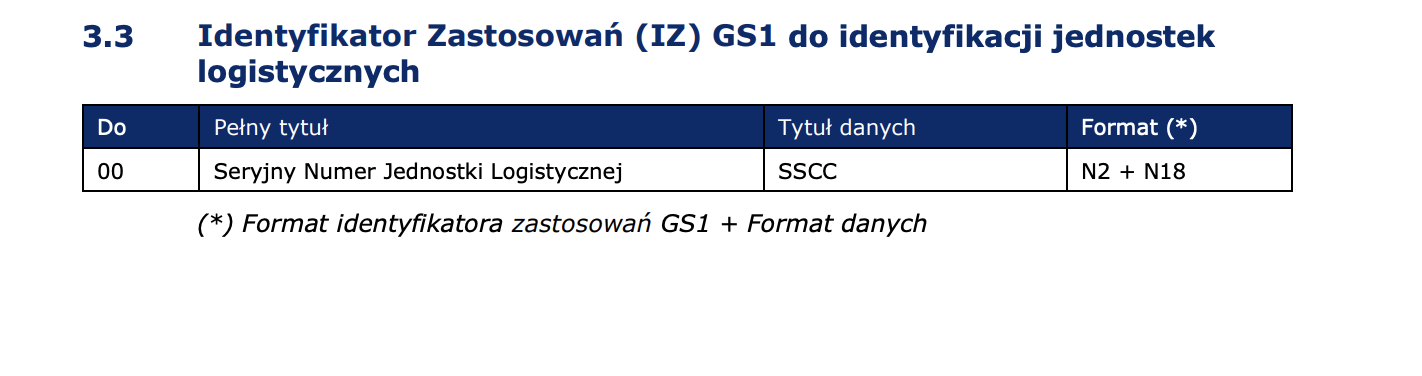
Source: https://gs1pl.org/app/uploads/2022/05/Wytyczne_dotyczace_etykiet_logistycznych_GS1.pdf
SSCC Structure
An SSCC number consists of several components:
- application identifier “00”, signaling SSCC format;
- extension digit (0–9), expanding numbering capacity;
- GS1 company prefix identifying the owner;
- serial reference uniquely identifying the logistics unit;
- check digit calculated using the GS1 algorithm.
A correctly generated SSCC is the only mandatory element of a GS1 logistics label. It should be created by the organization forming the logistics unit. If missing, it must be assigned by another supply chain participant.
How to Calculate the SSCC Check Digit
The check digit is calculated from the first 17 digits using the GS1 Modulo 10 algorithm:
- Starting from the right, multiply alternating digits by 3 and 1.
- Sum all results.
- Subtract the remainder (sum ÷ 10) from 10. If the result is 10, use 0.
Formula:
- S = 3 × (sum of digits in odd positions from the right) + 1 × (sum of digits in even positions)
- check digit = (10 − (S mod 10)) mod 10
This simple arithmetic ensures number validity and allows automated systems to detect scanning or data-entry errors.
Excel formula (17 digits in cell A1):
A1:=MOD(10-MOD(SUMPRODUCT(MID(TEXTJOIN("",TRUE,MID(A1,ROW(INDIRECT("1:17")),1)),18-ROW(INDIRECT("1:17")),1)*{3,1,3,1,3,1,3,1,3,1,3,1,3,1,3,1,3}),10),10)
Application Identifiers (AI): How to Read a GS1-128 Code
Application Identifiers (AI) are 2–3 digit prefixes that define the meaning of encoded data within GS1 barcodes. They standardize identification of logistics and product information.
They are mainly used on GS1 logistics labels and shipping packaging, represented as GS1 barcodes, 2D codes, or RFID tags.
Parentheses shown in printed text are not encoded, they serve only human-readable formatting.
Human-readable text (HRT) examples:
- (00)359012341234567890
- (01)05901234567890
Interpretation:
- digits in parentheses → application identifier;
- digits following → actual data;
- scanners read only numeric sequences and interpret them per GS1 standards.
Table 2: Example GS1-128 Application Identifiers
AI | Data meaning | Example (HRT) | What it identifies / purpose |
00 | SSCC | (00)359012341234567890 | identifies a logistics unit, pallet, container, master carton |
01 | GTIN | (01)05901234567890 | identifies a specific product |
02 | Contained GTIN | (02)05901234567890 | identifies the product contained within a logistics unit |
10 | Batch / lot number | (10)ABC123 | identifies a production batch (variable length) |
11 | Production date | (11)240101 | manufacturing date in YYMMDD format |
13 | Packaging date | (13)240105 | date the goods were packed |
15 | Best before date | (15)250630 | minimum durability / best before date |
17 | Expiration date | (17)250630 | product expiration date |
21 | Serial number | (21)SN123456 | individual item identifier |
30 | Quantity | (30)25 | number of items in the unit |
37 | Count of units | (37)12 | number of packages or components |
414 | Location GLN | (414)5901234000008 | identifies the delivery location |
420 | Postal code | (420)003590 | supports transport routing |
Source: https://gs1pl.org/app/uploads/2023/06/Identyfikatory_Zastosowania_GS1_2023.pdf
Where and How to Apply a GS1 Label, Technical Requirements
Scanning devices must be able to read GS1 logistics labels quickly and reliably. Proper placement ensures system functionality and traceability.
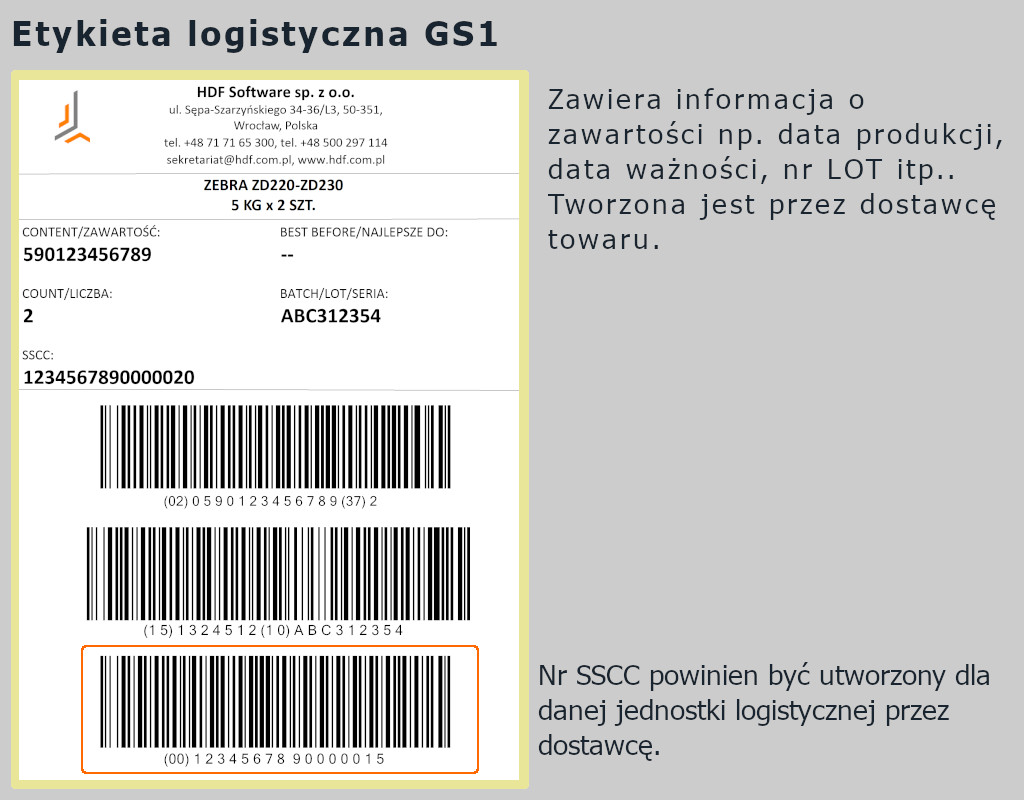
Practical mounting guidelines:
- apply two A5 GS1 labels per pallet;
- place them on adjacent sides;
- attach securely to stretch wrap in visible areas;
- additional markings (e.g., BOM) should be placed below the GS1 label with ≥50 mm margins;
- ensure barcode readability, no folds, dirt, or distortion.
Incorrect labeling may result in delivery rejection by distribution centers.
Automation, Making Labeling Easier with Excel Integration
To prepare GS1 labels correctly, you may use ready-made templates or dedicated label design software.
Example Excel file with SSCC calculation.
Typical workflow:
- Prepare a spreadsheet with GTIN, batch, SSCC data.
- Software imports data from Excel/CSV/SQL.
- Fields are mapped to the label layout.
- Barcodes are generated automatically.
- Batch printing produces multiple labels.
- Labels are sent directly to printers.
Such software is designed to be intuitive while allowing layout customization.
What Should GS1 Label Software Offer?
GS1-compliant software should support barcode generation, data integration, and workflow automation.
Solutions like HDF Labels demonstrate the importance of supporting multiple barcode formats (GS1-128, GS1 DataMatrix), database integration, and fast industrial printing.
These systems often include hundreds of barcode formats, Excel/SQL imports, and automatic numbering, significantly simplifying compliance with global standards.
Sources:
- https://gs1pl.org/app/uploads/2022/02/Manual_Palety_DC_JMP_marzec-2021-1.pdf
- https://gs1pl.org/app/uploads/2022/05/Wytyczne_dotyczace_etykiet_logistycznych_GS1.pdf
- https://gs1pl.org/app/uploads/2023/06/Identyfikatory_Zastosowania_GS1_2023.pdf
- https://gs1pl.org/